You’ve built a lot: an understanding of your anxiety, a body toolkit, thought tools, a real-time toolkit, an exposure ladder, strategies for work, relationships, and sleep, a values compass, a maintenance routine, a setback plan, and a clear sense of when to get help. This final lesson brings it all together into a long-term resilience plan.
Resilience here doesn’t mean never struggling. It means having the skills, habits, relationships, and self-understanding to bend without breaking, and to recover when you do.
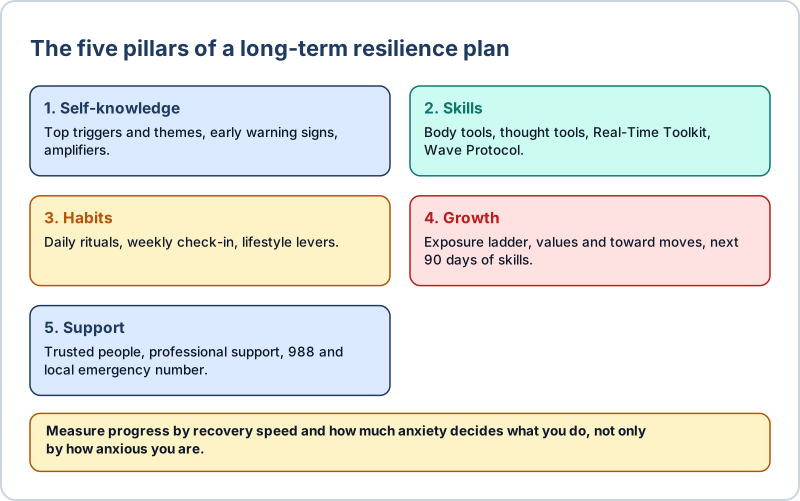
Five pillars of your resilience plan
Pillar 1: Self-knowledge – Your top triggers and themes – Your early warning signs – Your amplifiers
Pillar 2: Skills – Your top body tools (somatic, breathing, PMR) – Your top thought tools (Four-Question Check, uncertainty phrases, Worry Window) – Your real-time toolkit – Your Wave Protocol
Pillar 3: Habits – Your daily rituals (morning, evening) – Your weekly check-in – Your lifestyle levers
Pillar 4: Growth – Your current exposure ladder and the next one after it – Your values and your next toward moves – Your skill-building for the next 90 days
Pillar 5: Support – Your trusted people – Professional support (current or planned) – 988 and your local emergency number
Measuring progress
Track again. Repeat the 7-day tracker (Worksheet 1.4) and compare it with your first week:
- Has your average baseline changed?
- Are spikes shorter or less intense?
- Are you recovering faster?
- Are you doing things you were avoiding?
- Are you acting on your values more consistently?
The most meaningful measures are often not “how anxious am I?” but “How quickly do I recover?” and “How much is anxiety deciding what I do?”
Planning the next 90 days
Divide the next three months into phases:
- Days 1–30: Consolidate. Keep your personal protocol running daily. Finish your current exposure ladder. Retake the self-assessment at day 30.
- Days 31–60: Expand. Start a new ladder in a different area of life. Add one lifestyle lever experiment. Deepen one values area.
- Days 61–90: Integrate. Reduce how often you need to use tools formally. Notice where skills have become automatic. Review and update your Anxiety Response Plan. Plan the next 90 days.
Anticipating future challenges
Resilience includes preparing for predictable pressures. List the known stressors in the next year (a busy season, a job transition, a family event, travel, a medical procedure) and write a short plan for each. Include which tools you’ll use, how you’ll adjust your routine, and who you’ll tell.
Your “letter from steady”
A final exercise: write a short letter to yourself from the version of you who is steadier and living by their values. Write it for your future self to read during a hard time. Include:
- What you’ve learned about your anxiety
- What you know helps
- A reminder of what you’ve already faced and handled
- What matters to you, and why it’s worth moving toward
- Kind words you’d want to hear
Keep it with your Anxiety Response Plan.
Imagine this
Imagine Victor, a founder who started the course white-knuckling through board meetings and sleeping five hours a night. He retakes the tracker. His average has moved from 5 to 3, and his spikes last minutes instead of afternoons. He has spoken up at three board meetings, delegated two major projects, and kept to a caffeine cutoff. He still gets anxious, but it doesn’t decide what he does anymore. His 90-day plan: a new exposure ladder for delegating to his leadership team, and a Tuesday phone-free dinner with his family.
Action Step
Complete Worksheet 6.5: My Long-Term Resilience Plan. Fill in all five pillars, compare your first and final tracking weeks, list your anticipated challenges for the year with a mini-plan for each, and write your “letter from steady.” Then turn to the final page of the workbook, Your 30/60/90-Day Plan.