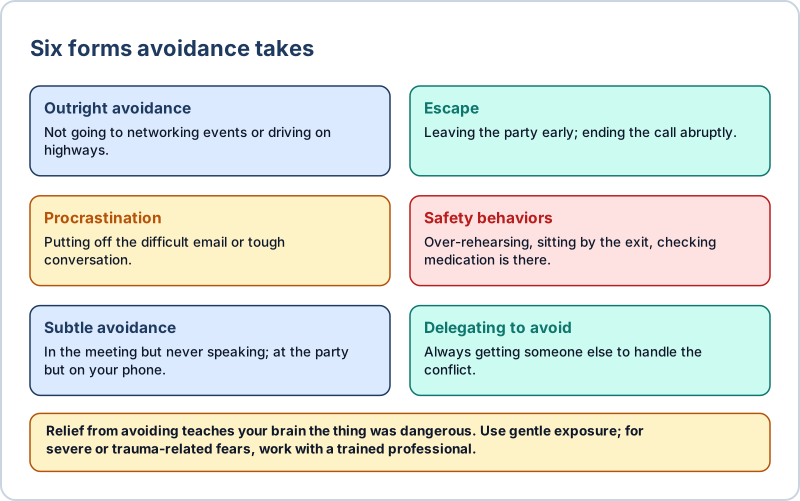
If there’s one idea in this course to remember, it’s this: avoidance is one of the main things that keeps anxiety going. Every time you avoid something because of anxiety, you feel relief. That relief teaches your brain that the thing was dangerous and that avoiding it kept you safe. Next time, the anxiety is a little stronger and avoiding is a little more tempting.
The approach that works with this is exposure: gradually and deliberately approaching what you’ve been avoiding, in manageable steps, so your brain can learn from experience that you can handle it. Exposure-based approaches are among the best-researched tools in anxiety psychology. Psychologist Michelle Craske and colleagues at UCLA have developed an influential account called the inhibitory learning approach. It suggests that exposure works less by “wearing out” fear and more by helping you learn new, competing information, such as “I can tolerate this” or “The feared outcome didn’t happen.”
This lesson teaches the self-help version: gentle, paced, and on your terms. For severe fears, trauma-related fears, or anything that feels overwhelming, work with a trained professional.
Spotting avoidance
Avoidance isn’t always obvious. It comes in several forms:
| Type | Examples |
|---|---|
| Outright avoidance | Not going to networking events; not driving on highways; not opening bank statements |
| Escape | Leaving the party early; ending the call abruptly |
| Procrastination | Putting off the difficult email, the doctor’s appointment, the tough conversation |
| Safety behaviors | Only going if a friend comes too; over-rehearsing every sentence; always sitting by the exit; carrying medication “just in case” and checking it’s there repeatedly |
| Subtle avoidance | Being in the meeting but never speaking; being at the party but on your phone |
| Delegating to avoid | Always getting someone else to make the calls or handle the conflict |
Safety behaviors deserve special attention. They’re things you do to feel safer during a feared situation, and they can quietly prevent learning. If you only ever give presentations with a fully memorized script, your brain never learns you can handle it. It learns the script saved you.
A note on medication: never change how you take any prescribed medication as part of an exposure exercise. Discuss any changes with your prescriber.
Protocol 11: The Exposure Ladder
Step 1: Choose a target. Pick one area of avoidance that matters to you. It should be something that’s shrinking your life or your work. For example: “Speaking up in leadership meetings.”
Step 2: Build a ladder of 8 to 10 steps. List situations related to the target, from mildly uncomfortable (around 2 to 3 out of 10) up to the hardest (8 to 10). Example:
| Step | Situation | Predicted anxiety (0–10) |
|---|---|---|
| 1 | Ask one clarifying question in a small team meeting | 3 |
| 2 | Share one opinion in a small team meeting | 4 |
| 3 | Ask one question in a leadership meeting | 5 |
| 4 | Comment briefly on someone else’s point in a leadership meeting | 5 |
| 5 | Share an idea in a leadership meeting without a script | 6 |
| 6 | Disagree respectfully with a peer in a small meeting | 6 |
| 7 | Present a 3-minute update to leadership | 7 |
| 8 | Disagree respectfully in a leadership meeting | 8 |
| 9 | Lead a 15-minute agenda item for leadership | 8 |
Step 3: Start low and stay long enough to learn. Begin at a step that’s challenging but doable, usually around 3 to 4. Before each exposure, write down:
- What you predict will happen (be specific: “My voice will shake and people will look at each other”)
- How anxious you expect to get (0–10)
Step 4: Do it, and drop safety behaviors where you can. Let the anxiety be there. Use Tier 1 tools to ride it, not to escape it. Try to stay in the situation until you’ve had a chance to learn something, rather than leaving at the peak.
Step 5: Review. Afterward, write down:
- What actually happened
- Your peak anxiety
- What you learned: “My voice shook slightly, and nobody seemed to notice. I got through it.”
Step 6: Repeat and climb. Repeat a step a few times, ideally on different days and in different settings. Move up when it feels more manageable. Variety helps, so if you can, practice in different rooms and with different people.
Principles for doing it gently and effectively
- Choose; don’t force. You’re the one deciding. Exposure you choose feels very different from being thrown in.
- Aim for “challenging but doable.” If a step feels overwhelming, add a smaller step below it.
- Expect anxiety. It’s not a sign things are going wrong. It’s part of the process.
- Regular beats heroic. Several small exposures a week work better than one huge one a month.
- Celebrate approach, not calm. Doing it anxious is the win.
- Know when to get help. If you can’t find a manageable first step, if exposure brings up trauma memories, or if the avoidance is severe, a professional can guide the process safely.
Imagine this
Nadia, a project lead, hasn’t spoken in a leadership meeting in eight months. She builds the ladder above. She starts at step 1 and predicts a 3 and people noticing her nerves. Her actual anxiety is 4, and no one notices. After three weeks she reaches step 5. Her voice wobbles at first. Her director replies, “Good point, let’s look at that.” She writes: “I can be nervous and still be heard.” That sentence is worth more than any amount of reassurance.
Action Step
Complete Worksheet 5.1: My Exposure Ladder. List your top three areas of avoidance, choose one, and build an 8 to 10 step ladder. Record your predictions and results for each exposure. Aim for at least three exposures a week for the next three weeks.