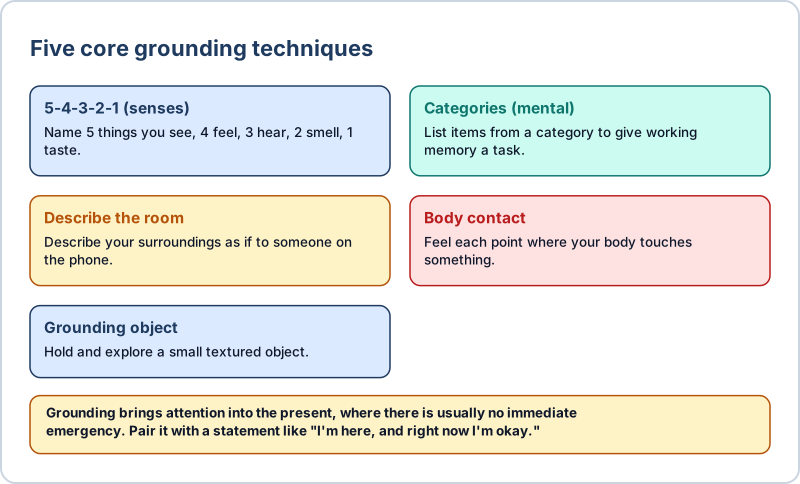
Grounding means bringing your attention firmly into the present moment through your senses and body. Anxiety lives in the future (“what if”), and rumination lives in the past (“why did I”). Grounding brings you back to now, where there’s usually no immediate emergency.
Grounding is especially helpful when you’re overwhelmed, spiraling, or feeling detached or “unreal,” a state that can accompany strong anxiety.
Five core grounding techniques
1. 5-4-3-2-1 (senses)
Name, silently or out loud: – 5 things you can see – 4 things you can physically feel (the chair under you, your feet in your shoes, the air on your skin) – 3 things you can hear – 2 things you can smell (or two smells you like, if nothing is around) – 1 thing you can taste (or one thing you’re grateful for)
Go slowly. Describe each item in detail: “A blue mug with a chip on the handle,” not just “mug.”
2. Categories (mental)
Choose a category and list items from it: dog breeds, cities starting with “B,” players on your favorite team, ingredients in a recipe you know well. This gives your working memory a task, which crowds out worry. It’s excellent at night and on commutes.
3. Describe the room (external focus)
Describe your surroundings as if to someone on the phone who can’t see them: “I’m in a gray office. There’s a window to my left with blinds half-closed. The desk has a laptop, a green notebook…” This is completely discreet if you do it in your head.
4. Body contact (physical)
Feel every point where your body makes contact with something: your feet on the floor, your back against the chair, your hands on the desk, your clothes on your shoulders. Press into each one gently. Notice the pressure, the temperature, and the texture.
5. Grounding object (tactile)
Carry a small object with an interesting texture, like a smooth stone, a ring, a keychain, or a textured card. When anxiety rises, hold it and explore it with your fingers. Over time it can become a cue linked with steadiness.
Grounding statements
Pair any technique with a statement that orients you in time and place:
- “My name is . Today is . I’m at ___. I’m safe right now.”
- “This is a feeling, and feelings pass.”
- “I’m here, in this room, and right now I’m okay.”
Matching grounding to the situation
| Situation | Best grounding options |
|---|---|
| In a meeting | Body contact, describe the room (silently), grounding object |
| Driving | Describe the road out loud, body contact (hands on the wheel, back on the seat); not eyes-closed techniques |
| Lying awake at night | Categories, body contact |
| Feeling unreal or detached | 5-4-3-2-1 out loud, grounding object, a strong sensory anchor (Lesson 2.4, #6) |
| With kids around | 5-4-3-2-1 as a game (“Let’s find five blue things!”), body contact |
| After a difficult phone call | Walking plus describing what you see |
Grounding versus avoidance
There’s an important difference between grounding and distraction as avoidance:
- Grounding helps you come back to the present so you can function and stay engaged with what’s in front of you.
- Avoidance pushes the feeling away so you never have to experience it.
The test: Am I using this to stay present and keep going, or to escape the feeling entirely? Grounding that helps you return to your meeting, your conversation, or your sleep is healthy. Grounding used over and over to avoid ever feeling any anxiety at all can keep the loop going.
Practice
Like breathing, grounding works best when it’s familiar. Practice one technique once a day for a week when you’re calm, like on your commute, while waiting in line, or during your morning coffee. By the time you need it, it will be automatic.
Imagine this
Rosa, a teacher and mother of three, feels overwhelmed during the chaos of the after-school pickup, homework, and dinner. She turns 5-4-3-2-1 into a game with her kids in the car: “Five red things!” It grounds her, the kids love it, and no one knows it’s an anxiety tool. At night, when her mind races, she uses categories: “Countries in Africa… Kenya, Ghana, Egypt…” She’s usually asleep before she runs out.
Action Step
Complete Worksheet 4.2: My Grounding Toolkit. Practice each of the five core techniques at least once over the next week and rate how well each one worked for you. Choose your top two, write your personal grounding statement, and choose a grounding object. Add your top grounding tool to your Real-Time Toolkit Cards.