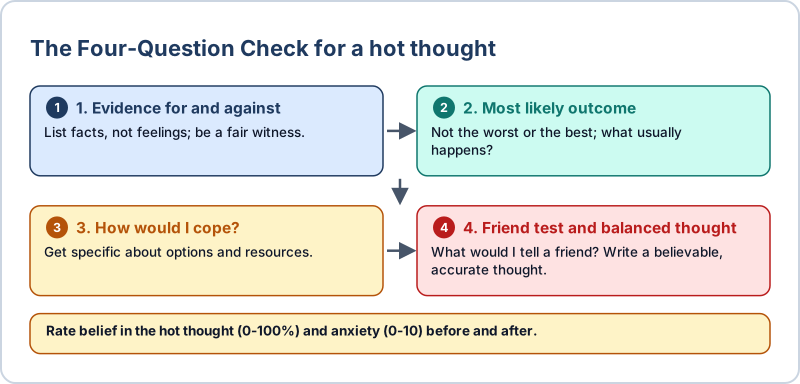
Once you’ve caught a hot thought, you can test it. Not argue with it, and not suppress it. Test it, the way a good scientist or a fair judge would. The Four-Question Check condenses the core of CBT-style thought evaluation into four questions you can run in two minutes on paper, or in thirty seconds in your head once you’ve practiced.
Protocol 6: The Four-Question Check
Question 1: What’s the evidence, for and against?
List the facts (not feelings or interpretations) that support the thought, and the facts that don’t. Be a fair witness.
- Hot thought: “My boss thinks I’m incompetent.”
- For: She rewrote two slides in my deck. Her reply to my email was short.
- Against: She gave me the Q4 project. She thanked me in last week’s meeting. She sends short replies to everyone. She rewrites everyone’s slides.
Question 2: What’s the most likely outcome, not the worst or the best?
Anxiety jumps straight to the worst case. Ask yourself, “If I think about all the ways this could go, what’s most likely? Based on past experience, what usually happens?”
- Worst: She’s building a case to fire me.
- Best: She thinks I’m brilliant, and the edits were random.
- Most likely: She’s busy, she has strong opinions about slides, and she thinks I’m solid.
Question 3: If the feared outcome did happen, how would I cope?
This addresses the second half of catastrophizing, which is underestimating your ability to cope. Get specific: “If she really does have concerns, I’d ask for direct feedback. I’d work on the specific issues. I’d use my network. I’ve dealt with difficult feedback before, including ___.”
You’re not saying the bad outcome would be fine. You’re recognizing that you’d have options and resources.
Question 4: What would I tell a friend, and what’s a more balanced thought?
People are much fairer to friends than to themselves. Imagine a respected colleague brought you this exact situation. What would you say? Then write a balanced thought that is believable and accurate, not just cheerful.
- Balanced thought: “I don’t have evidence that she thinks I’m incompetent, and I do have evidence that she trusts me with important work. The edits are probably about her style. If I want clarity, I can ask for feedback in our next one-on-one.”
Rate before and after
- Rate how much you believe the hot thought (0–100%) before and after.
- Rate your anxiety (0–10) before and after.
A typical result is something like believing the thought drops from 80% to 40%, and anxiety drops from 7 to 4. That’s a real, meaningful shift. Don’t expect it to fall to zero.
Common problems and fixes
| Problem | Fix |
|---|---|
| “I know the balanced thought is true, but I don’t feel it.” | That’s normal. Feelings lag behind thinking. Repetition, and acting on the balanced thought, closes the gap over time. |
| “I can’t find any evidence against it.” | Ask: “What would someone who loves me point out? What happened the last ten times?” |
| “The feared outcome actually is likely.” | Then it may be a real problem. Go back to the Worry Sort (Lesson 1.3) and use problem-solving. |
| “I keep running the check over and over.” | Limit it to one check per thought per day. After that, use the tools in Lessons 3.3 and 3.4. |
| “The balanced thought sounds fake.” | Make it smaller and more honest: “I don’t know for sure, and I’ve gotten through things like this before.” |
Using it in real time
Once you’ve done the written version ten or so times, you can do a quick version in your head:
- Evidence? “Mixed at best.”
- Most likely? “She’s busy.”
- Could I cope? “Yes, I’d ask.”
- Friend version? “You’re reading tea leaves.”
This quick version is one of the cards in the Real-Time Toolkit (Lesson 4.1).
A note on timing
Remember Lesson 2.2. If your anxiety is at 8 or higher, your thinking brain is only partly available. Use your body tools first to bring it down a couple of points. Then run the check.
Imagine this
Aisha, a new department head, has a hot thought: “The team will see I’m not ready for this.” Evidence for: two tense meetings, and one person is openly skeptical. Evidence against: she was chosen from six candidates, four team members have asked her for advice, and she has led through a hard transition before. Most likely: some people are adjusting, and she’s learning. Coping: she’d ask her mentor for advice and meet one-on-one with the skeptic. Balanced thought: “I’m new, so some awkwardness is expected. The evidence says I was chosen for good reasons, and I’m building trust.” Belief in the hot thought drops from 85% to 45%, and her anxiety drops from 7 to 4.
Action Step
Complete Worksheet 3.2: The Four-Question Check, which includes the printable pocket card version. Work through three hot thoughts from your Worksheet 3.1 log using the full written format. Rate your belief and anxiety before and after each one. Then practice the quick in-your-head version once a day for a week.