If you’re in crisis or thinking about harming yourself, call or text 988 (US) or your local emergency number.
Setbacks aren’t a sign that the course failed or that you failed. Progress with anxiety almost never goes in a straight line. It looks more like a jagged upward slope, with good weeks, hard weeks, and the occasional flare that makes you feel like you’re back at the start. You’re not. This lesson helps you recognize a setback early, respond skillfully, and learn from it.
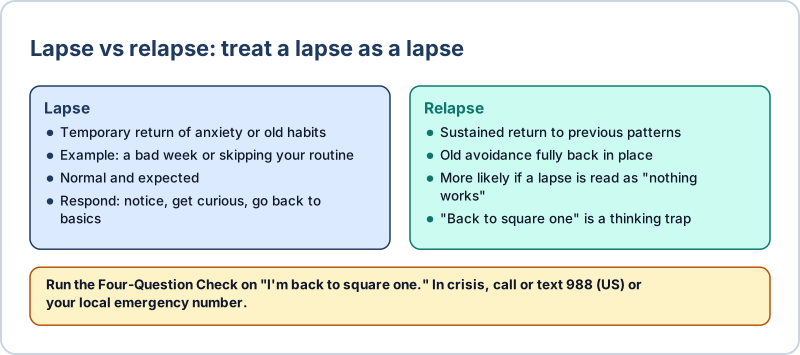
Lapse versus relapse
It helps to separate two things:
- A lapse is a temporary return of anxiety or old habits. For example: a bad week, a panic surge, falling back into checking, or skipping your routine for ten days. Lapses are normal and expected.
- A relapse is a sustained return to previous patterns over a longer period, with old avoidance fully back in place. A lapse is more likely to grow into one when it’s treated as proof that “nothing works.”
The most important move is to treat a lapse as a lapse, not a catastrophe. The thought “I’m back to square one” is itself a thinking trap (all-or-nothing and catastrophizing). Run the Four-Question Check on it.
Common setback triggers
- Major life stress (job loss, illness, a breakup, a move, a new baby)
- Sleep disruption (travel, a newborn, shift work)
- Hormonal or health changes (talk to your doctor about these)
- Stopping your routine because “I’m fine now”
- An encounter with an old, strong trigger
- Seasonal changes, anniversaries, or holidays
- Using more alcohol or caffeine during stressful times
Early warning signs of a setback
List your own. Common ones:
- Your average rating creeps up over a week or two
- Old safety behaviors come back (checking, reassurance seeking)
- New avoidance: canceling, delaying, “not this time”
- Sleep gets worse
- You drop your morning or evening ritual
- More replaying and what-if chaining
- Irritability, withdrawal from people
The setback response plan
When you notice warning signs:
- Notice and name it. “This looks like a lapse. Lapses are normal.”
- Get curious, not critical. “What’s changed? Sleep? Stress? Did I stop my routine?”
- Go back to basics. Restart your minimum viable protocol (Lesson 6.2): consistent wake time, breathing, the three-line review.
- Check your lifestyle levers. Caffeine, alcohol, sleep, movement.
- Re-approach avoidance. Go back a step or two on your Exposure Ladder and climb again. It’s usually faster the second time.
- Review your Anxiety Response Plan (Lesson 4.5) and use it.
- Reach out. Tell a trusted person. Consider a professional if the lapse lasts more than a couple of weeks or keeps getting worse.
- Be kind to yourself. Self-criticism adds fuel. Try: “This is hard, and I’ve gotten through hard before.”
Self-compassion as a practical skill
High-functioning people are often harsh with themselves: “I should be over this by now.” Psychologist Kristin Neff’s research on self-compassion describes three components: mindfulness (acknowledging the pain without exaggerating it), common humanity (recognizing that struggle is part of being human, not a personal flaw), and self-kindness (treating yourself as you’d treat a good friend).
A short practice for setback moments:
- “This is a hard moment.” (mindfulness)
- “Lots of people struggle with anxiety. I’m not alone in this.” (common humanity)
- “What would I say to a friend right now? Can I say that to myself?” (self-kindness)
When a setback is a signal
Sometimes a setback is more than a lapse. It’s a sign that you need more support. Contact a professional if:
- The setback lasts more than two to four weeks despite using your tools
- Anxiety is significantly affecting your work, relationships, or health
- You experience panic attacks, especially new or frequent ones
- You notice persistent low mood, hopelessness, or loss of interest
- You’re relying on alcohol or other substances to cope
- You have any thoughts of harming yourself, in which case contact 988 or emergency services right away
See Lesson 6.4 for more.
Imagine this
Imagine Isaac, who has been steady for three months, when a restructuring is announced. Within a week he’s checking email at midnight, skipping his rituals, and replaying every meeting. On Friday, during his weekly check-in, he notices his average has jumped from 3 to 6. He names it a lapse, goes back to his minimum viable protocol, sets email hours again, and tells his partner. He runs the Four-Question Check on “I’m back to square one.” Within two weeks his average is back to 4. His note: “Setback lasted 10 days, not 10 months. That’s the progress.”
Action Step
Complete Worksheet 6.3: My Setback Plan. List your personal setback triggers and early warning signs, write your step-by-step setback response plan, and write a short self-compassion script in your own words. Include the “time to get more support” criteria and your support contacts.