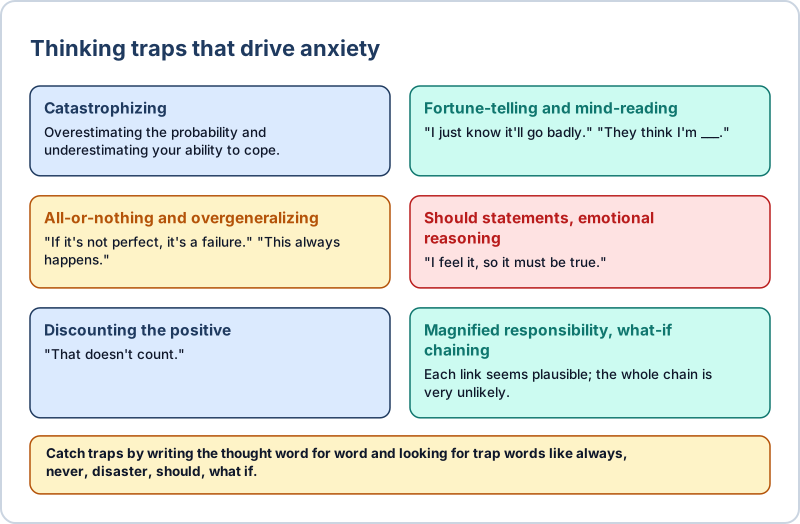
In the 1960s, psychiatrist Aaron Beck noticed that his patients’ emotional distress was tied to automatic thoughts that followed predictable, biased patterns. He called these patterns cognitive distortions. Psychiatrist David Burns later made them widely known in his 1980 book Feeling Good. These patterns aren’t signs of stupidity or weakness. They’re mental shortcuts that everyone uses, and anxiety tends to over-use them.
Why “catastrophic”?
The thinking pattern most strongly tied to anxiety is catastrophizing, where you jump to the worst possible outcome and treat it as likely. It usually has two parts:
- Overestimating the probability: “This will go wrong.”
- Underestimating your ability to cope: “And if it does, I won’t be able to handle it.”
Most anxiety thought work comes down to correcting both parts.
The eight thinking traps that drive most anxiety
| Trap | What it sounds like | Example |
|---|---|---|
| Catastrophizing | “This will be a disaster.” | “If I stumble in this pitch, the whole deal is dead and my reputation is ruined.” |
| Fortune-telling | “I just know it’ll go badly.” | “They’re going to say no.” |
| Mind-reading | “They think I’m ___.” | “My boss’s short reply means she’s disappointed in me.” |
| All-or-nothing thinking | “If it’s not perfect, it’s a failure.” | “One typo means the whole report is sloppy.” |
| Overgeneralizing | “This always happens.” | “I always freeze in meetings.” |
| “Should” statements | “I should be able to handle this.” | “I shouldn’t be anxious about something this small.” |
| Emotional reasoning | “I feel it, so it must be true.” | “I feel like something bad is about to happen, so it probably will.” |
| Discounting the positive | “That doesn’t count.” | “The client liked it, but they were just being polite.” |
Two more deserve a mention for high-functioning people:
- Magnified responsibility: “If anything goes wrong, it’s on me to have prevented it.”
- What-if chaining: “What if the flight is delayed, and then I miss the connection, and then I miss the meeting, and then…” Each link seems plausible, but the whole chain is very unlikely.
How to catch traps in the wild
Distortions are fast and they feel true. You’ll catch them more easily if you:
- Write the thought down, word for word. “I’m going to get fired” looks different on paper than it feels in your head.
- Look for trap words, like always, never, everyone, disaster, ruined, can’t, should, must, what if.
- Ask, “Which trap is this?” Just naming it creates some distance, the same way naming the anxiety loop does in Notice, Name, Navigate.
Thoughts often contain several traps at once. “I always mess up presentations, and everyone will see I’m a fraud” has overgeneralizing, fortune-telling, mind-reading, and catastrophizing all in one sentence.
Hot thoughts
Not every thought during an anxious moment is equally important. Look for the hot thought, the one that carries the most emotional charge. A good way to find it is to keep asking, “And if that’s true, what would it mean?”
- “The client hasn’t replied.” → What would that mean?
- “They’re unhappy with the proposal.” → And if that’s true?
- “We’ll lose the account.” → And if that’s true?
- “I’ll have failed my team, and they’ll think I’m not up to the job.” ← hot thought
The hot thought is what you’ll test in Lesson 3.2. Working on surface thoughts (“they haven’t replied”) brings only a little relief. Working on the hot thought brings real relief.
What thought work is and isn’t
Cognitive work is not positive thinking. You’re not replacing “This will be a disaster” with “Everything will be perfect.” You’re aiming for thoughts that are more accurate, more balanced, and more useful. Often that sounds like: “This might not go perfectly, and if it doesn’t, it would be uncomfortable, and I would handle it.”
It’s also not about arguing with yourself endlessly. If you find yourself building a legal case against every anxious thought, several times a day, that can turn into another form of rumination. Lesson 3.3 covers what to do instead.
Imagine this
Sam, a software engineer, has a thought before his performance review: “I’m going to get a terrible review and be put on a performance plan.” He writes it down and spots fortune-telling and catastrophizing. He follows it down: “…and then I’ll be fired, and I’ll never find another job this good.” That’s the hot thought, and it has what-if chaining and overgeneralizing on top. Just seeing all this laid out on paper drops his anxiety from 7 to 5, before he has done any challenging at all.
Action Step
Complete Worksheet 3.1: The Thinking Trap Log. For five days, write down one anxious thought a day, word for word. Identify which traps it contains, and follow it down with “And if that’s true, what would it mean?” until you find the hot thought. Bring these hot thoughts to Lesson 3.2.