The quiet of night is when many anxious minds become loudest. With no meetings, kids, or tasks to fill the space, worries rush in. Then worrying about not sleeping becomes its own layer of anxiety. This lesson gives you practical tools drawn from well-established sleep and anxiety approaches.
This is general sleep education. If you have ongoing insomnia, loud snoring, gasping during sleep, or severe daytime sleepiness, talk with a doctor. Some sleep problems, like sleep apnea, need medical assessment. Cognitive Behavioral Therapy for Insomnia (CBT-I) is a well-established, structured program you can get through trained clinicians.
Before bed: the wind-down
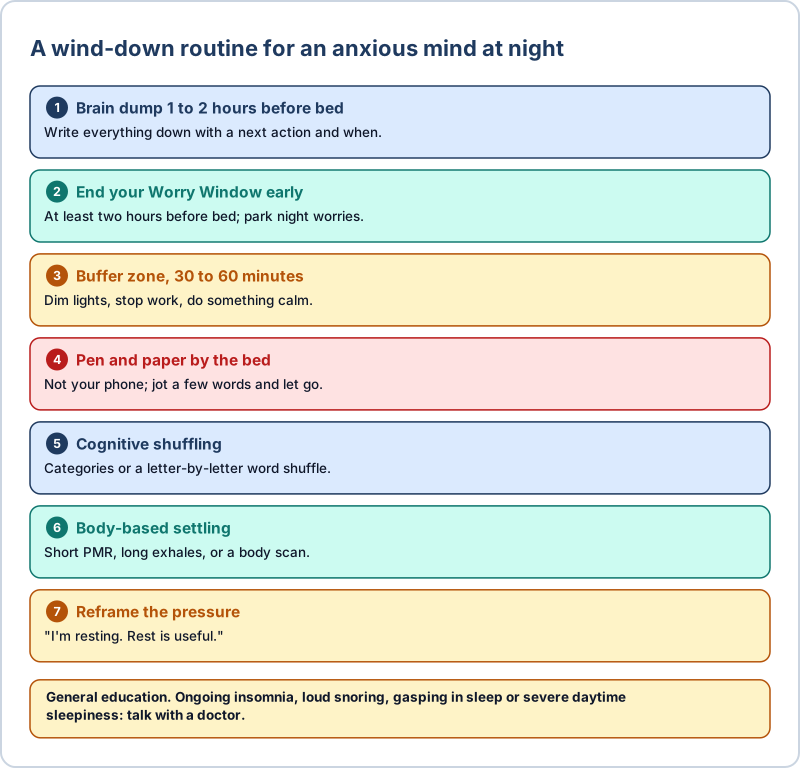
1. Do a “brain dump” 1 to 2 hours before bed. Write down everything on your mind: tasks, worries, loose ends. For each task, note a next action and when you’ll do it. This gives your brain a clear signal that everything is captured and handled.
2. Keep your Worry Window earlier. Your daily Worry Window (Lesson 3.4) should end at least two hours before bed. If worries come up at night, they get parked for tomorrow’s window.
3. Create a buffer zone. For 30 to 60 minutes before bed: dim the lights, stop working, close email, and do something calming and low-stakes, like reading fiction, taking a warm shower, gentle stretching, or listening to music.
4. Keep a pen and paper by the bed. Not your phone. If something important comes up, jot it down in a few words and let it go.
In bed: settling the mind
Cognitive shuffling and categories. Worry is a coherent, story-like kind of thinking. Scrambled, neutral images and words can crowd it out. Try:
- Categories (Lesson 4.2): fruits, cities, famous musicians.
- Letter-by-letter shuffle: Pick a neutral word, like “garden.” For each letter, picture as many unrelated items as you can starting with that letter (G: goat, guitar, grapes… A: apple, anchor…).
Body-based settling:
- Short PMR (Lesson 4.3), lying down.
- Long-exhale breathing (4 in, 6 to 8 out) or slow cyclic sighing.
- A body scan: Slowly move your attention from your toes to your head, noticing and softening each area.
Reframe the pressure to sleep. Trying hard to sleep tends to backfire. Try: “I’m resting. Rest is useful even if I don’t fall asleep right away.” Taking the pressure off can make sleep easier.
When you can’t sleep: get up
A core part of CBT-I comes from psychologist Richard Bootzin’s stimulus control approach, developed in the 1970s. The idea is to keep your bed strongly linked with sleep, not with lying awake worrying.
- If you’ve been awake for what feels like about 20 minutes (don’t clock-watch), get up.
- Go to another room with dim light and do something calm and dull, like reading something boring or folding laundry. Avoid screens if you can.
- Return to bed when you feel sleepy.
- Repeat as needed.
- Keep your wake time consistent, even after a bad night.
It feels counterintuitive, but over time it helps retrain the link between bed and sleep.
The 3am spiral
Many people wake in the early hours with racing thoughts. At that hour, problems seem bigger and solutions seem further away. Try saying: “This is a 3am thought. 3am thoughts always seem worse. I’ll look at it in daylight.” Then:
- Spiral Interruption Guide (Lesson 3.4), the short version.
- Park it: Write two words on the notepad.
- Settle: Cognitive shuffle or long exhales.
- If you’re still awake after about 20 minutes, get up briefly, as described above.
Daytime habits that support sleep
These come from Lesson 2.5:
- Keep a consistent wake time.
- Get outdoor light in the morning.
- Set a caffeine cutoff (for example, noon).
- Be careful with alcohol close to bed.
- Keep naps short (under 30 minutes) and early, or skip them if nighttime sleep is hard.
- Move during the day.
Imagine this
Omar, a restaurant owner, lies awake every night running through orders, staff issues, and cash flow. He starts a 9pm brain dump, sets his phone to charge in the kitchen, and uses cognitive shuffling in bed. When he wakes at 3am, he says, “3am thought, look at it tomorrow,” writes “linen order” on his notepad, and does long exhales. On two nights he gets up and reads a dull trade magazine in the living room. After three weeks he’s falling asleep noticeably faster most nights.
Action Step
Complete Worksheet 5.4: My Wind-Down Routine and Sleep Log. Design your wind-down routine (brain dump time, buffer activities, and in-bed tools), then track your sleep for two weeks: bedtime, rough time to fall asleep, wake-ups, wake time, and which tools you used. Look at the patterns at the end.