If you’re in crisis or thinking about harming yourself, call or text 988 (US) or your local emergency number. The 988 Suicide & Crisis Lifeline is free, confidential, and available 24/7 by call, text, or chat. Outside the US, contact your local emergency number or crisis service.
This course teaches self-help skills. For many people with everyday, non-clinical anxiety, those skills make a real difference. But self-help has limits, and knowing when to get professional support is one of the most important skills in this course. Seeking help is not a failure of self-help. It’s a smart use of resources, the same way you’d hire an expert for anything else that matters.
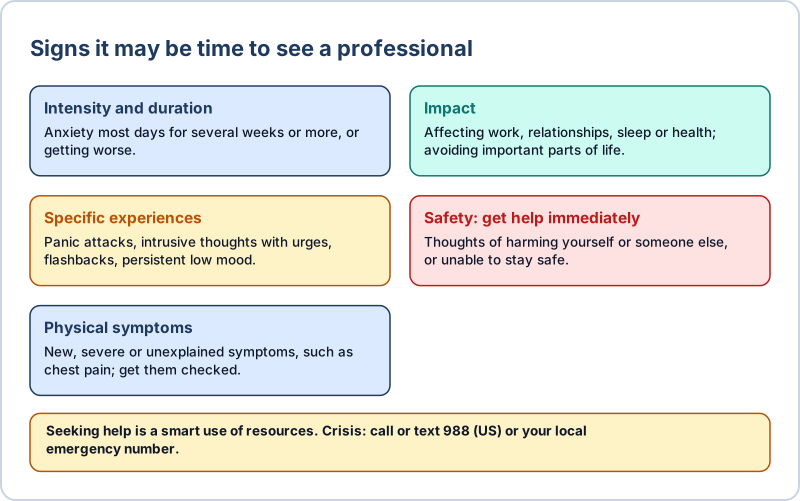
Signs it’s time to see a professional
Consider reaching out to a doctor or licensed mental health professional if any of these apply:
Intensity and duration – Anxiety most days for several weeks or more, despite using the tools in this course – Anxiety that’s getting worse over time, not better
Impact – It’s significantly affecting your work, relationships, parenting, sleep, or health – You’re avoiding important parts of your life (work tasks, driving, leaving home, social contact) – You’re struggling to do daily tasks
Specific experiences – Panic attacks, especially frequent ones or ones that leave you afraid of the next one – Unwanted, intrusive thoughts or images that feel disturbing, with urges to do things (checking, counting, cleaning, mental rituals) to neutralize them – Flashbacks, nightmares, or strong reactions linked to a traumatic event – Intense fear focused on your health, social situations, or specific things that is shrinking your life – Persistent low mood, hopelessness, or loss of interest or pleasure – Using alcohol, drugs, or other behaviors to cope that are becoming a concern – Changes in eating or sleep that concern you
Safety (get help immediately) – Any thoughts of harming yourself or ending your life – Feeling unable to keep yourself safe – Any thoughts of harming someone else
Physical symptoms – New, severe, or unexplained physical symptoms, such as chest pain, breathing difficulties, fainting, or heart palpitations. Get these checked by a doctor. Some medical conditions (for example, thyroid problems) and some medications or substances can produce anxiety-like symptoms.
Who does what
| Professional | What they typically do |
|---|---|
| Primary care doctor / GP | A good first stop. Can rule out medical causes, discuss options, and refer you. |
| Psychologist | Assessment and evidence-based psychotherapy (such as CBT, ACT, exposure-based therapies). |
| Licensed therapist / counselor (for example LPC, LCSW, LMFT in the US) | Psychotherapy; many are trained in CBT and related approaches. |
| Psychiatrist | A medical doctor who can diagnose, prescribe, and manage medication, and sometimes also provides therapy. |
| Psychiatric nurse practitioner | In many areas, can assess and prescribe medication. |
Professional titles and licensing vary by country and state. Check what applies where you live.
How to find the right fit
- Start with your doctor, your insurance provider’s directory, or your workplace Employee Assistance Program (EAP), if you have one. Many EAPs offer a number of free, confidential sessions.
- Look for relevant training. For anxiety, ask about experience with CBT, exposure-based approaches, or ACT.
- Ask practical questions: cost, insurance, availability, telehealth or in-person, and session length.
- Use a first session as a fit check. It’s okay to try someone else if it doesn’t feel right. Your relationship with your therapist matters.
- Look at lower-cost options if cost is a barrier: sliding-scale clinics, university training clinics, community mental health centers, and group programs.
What to bring
Your work in this course can make your first appointments more productive. Consider bringing:
- Your Trigger Map (Worksheet 1.2)
- Your 7-day tracker (Worksheet 1.4)
- Your Anxiety Response Plan (Worksheet 4.5)
- A short list of what helps, what doesn’t, and what you’re most hoping to change
Using this course alongside professional care
Many people find structured self-help works well alongside therapy. If you’re working with a professional:
- Share what you’ve learned here, and let them guide which tools to use.
- Follow their advice if it differs from something in this course. They know your situation.
- Never stop or change prescribed medication without talking to your prescriber.
A script for asking for help
Reaching out can itself trigger anxiety. Here’s a simple script for a first call or email:
“Hi, I’m looking for help with anxiety. It’s been affecting my ___ (work / sleep / relationships) for about ___ (weeks / months). I’m interested in ___ (CBT / therapy / an assessment). Do you have availability, and do you accept ___ (insurance / sliding scale)?”
Action Step
Complete Worksheet 6.4: My Professional Support Check. Go through the checklist of signs honestly. If any apply, fill in the “next step” section: who you’ll contact, by when, and the script you’ll use. Everyone, whether or not signs apply, should fill in the support contacts section, including 988 and your local emergency number.