Memory is an unreliable narrator, especially when you’re anxious. You might remember “I was anxious all week” when the data shows two hard afternoons and five fine mornings. A week of simple tracking gives you facts to work with instead of impressions.
Why track?
Tracking gives you four things:
- Accuracy. You’ll see your real baseline, your peaks, and your quiet times.
- Patterns. Time of day, day of week, people, and conditions that line up with spikes.
- Leverage. You’ll see which small changes might have the biggest effect.
- A baseline to compare against. When you track again in week six, you’ll be able to see your progress instead of guessing at it.
What to track
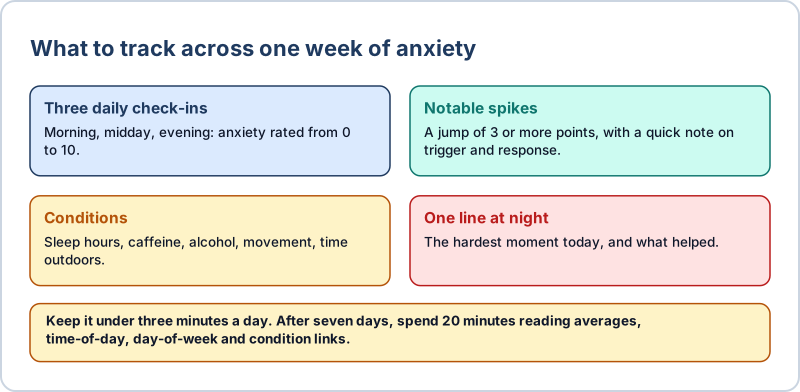
Keep it light. If tracking takes more than three minutes a day, you’ll stop. Track:
- Three check-ins a day (morning, midday, evening): your anxiety from 0 to 10.
- Notable spikes: any time anxiety jumped 3 or more points, with a quick note on the trigger and what you did.
- Conditions: hours of sleep, caffeine (number of drinks and the time of the last one), alcohol, movement (yes or no), and time outdoors.
- One line at night: “The hardest moment today was . What helped was .”
How to rate from 0 to 10
Anchors keep your ratings consistent:
| Rating | What it feels like |
|---|---|
| 0–1 | Calm, at ease |
| 2–3 | Background hum; fully functional |
| 4–5 | Noticeable; attention partly pulled away |
| 6–7 | Strong; hard to focus; strong urge to escape or check |
| 8–9 | Very intense; hard to function |
| 10 | The most intense you have ever felt |
Don’t overthink it. Your first guess is fine. Consistency matters more than precision.
Reading your week
At the end of seven days, set aside 20 minutes and look for:
- Your average baseline. If your typical rating is a 4, your nervous system is running warm most of the time. Module 2 and the lifestyle levers in Lesson 2.5 will matter a lot for you.
- Time-of-day patterns. Morning spikes can be linked to things like checking your phone in bed, early caffeine on an empty stomach, or dread about the day ahead. Late-evening spikes are often about fatigue, screens, and rumination.
- Day-of-week patterns. The “Sunday scaries” are common. So are spikes before recurring meetings.
- Condition links. Compare days with less than six hours of sleep to days with seven or more. Compare three coffees to one.
- What helped. Look at your nightly lines. What actually brought a spike down? That’s the start of your Navigate menu.
- What you avoided. Note anything you skipped, delayed, or asked someone else to do because of anxiety. This becomes important in Lesson 5.1.
A caution about tracking
For a small number of people, especially those who tend to monitor their body closely, tracking can turn into its own form of checking. If you notice yourself rating every twenty minutes or feeling anxious about the tracking, stick to the three fixed check-ins and nothing more. The goal is information, not surveillance.
Imagine this
Leo, a sales lead, tracks for a week. His ratings average 3.5, which is lower than he expected. His four biggest spikes all happen between 3pm and 5pm, and three of those days he’d skipped lunch and had a third coffee around 2pm. He also notices he’d put off one difficult client call all week. The plan almost writes itself: eat lunch, have no coffee after 1pm, and make the client call first thing in the morning. He also adds a short walk after his 3pm meeting. These are small changes with leverage.
Action Step
Start Worksheet 1.4: The 7-Day Anxiety Pattern Tracker. Do three check-ins a day, note spikes and conditions, and write the nightly line. On day seven, complete the “Reading My Week” questions on the same worksheet. Keep this page, because you’ll compare it with a second tracking week in Module 6.