For high-functioning people, work is often where anxiety is both most active and most hidden. You may be seen as capable, even calm, while running a constant internal commentary of what-ifs. This lesson applies your tools to the most common work triggers.
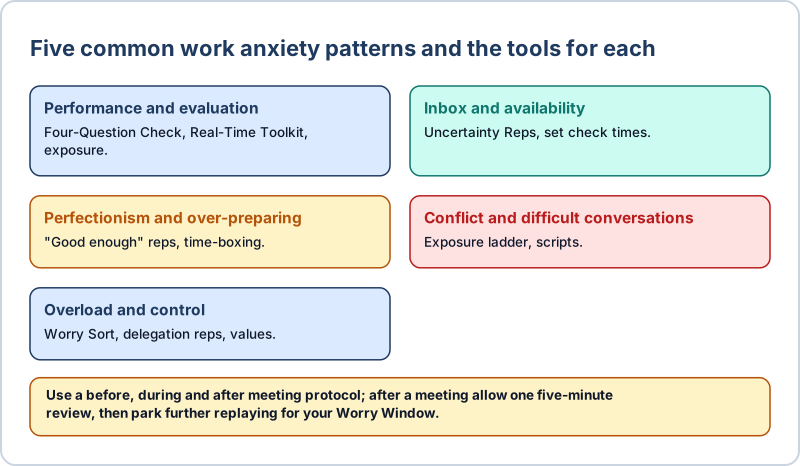
The five common work anxiety patterns
| Pattern | What it looks like | Primary tools |
|---|---|---|
| Performance and evaluation | Dread before presentations and reviews; replaying afterward | Four-Question Check, Real-Time Toolkit, exposure |
| Inbox and availability | Constant checking; anxious when offline | Uncertainty Reps, set check times |
| Perfectionism and over-preparing | Hours polishing; missing deadlines to get it “right” | “Good enough” reps, time-boxing |
| Conflict and difficult conversations | Avoiding feedback, confrontation, and saying no | Exposure ladder, scripts |
| Overload and control | Refusing to delegate; working late to feel safe | Worry Sort, delegation reps, values (Lesson 6.1) |
Before, during, and after: the meeting protocol
Before (the night before or morning of):
- Prepare reasonably. Set a time limit for preparation, such as 60 minutes for a routine presentation. Ask, “Is this extra prep making the outcome better, or just making me feel more certain?”
- Pre-decide your Navigate moves (Lesson 4.1): your Tier 1 tool and your pause script.
- Run the Four-Question Check on your hot thought about the meeting.
- Fuel your body. Eat something, keep caffeine moderate, and take a short walk beforehand.
During:
- Arrive a few minutes early. Orient yourself: look around the room and feel your feet on the floor.
- Relabel your arousal: “This is energy for the task.”
- Use Tier 1 tools as needed: 4-6 breaths, unclench the three, a slow sip of water.
- Stay present. Focus outward on what people are saying, not inward on how you’re coming across. Anxiety pulls attention inward. Deliberately put it back on the conversation.
After:
- Finish the stress cycle. Take a walk, climb stairs, or shake it out.
- Limit replay. Allow one five-minute review: “What went well? What would I do differently?” After that, park any further replaying for your Worry Window.
- Log what you learned, especially where your predictions didn’t come true.
The replay trap
Many anxious professionals spend hours after a meeting replaying what they said, how it landed, and what people thought. This is called post-event processing, and it tends to keep social and performance anxiety going. Your tools:
- One structured review, then stop.
- The Four-Question Check on the hot thought (“They think I’m an idiot”).
- Park it. “Replay goes to the Worry Window.”
- Redirect to an absorbing task.
Perfectionism reps
If over-preparing is your pattern, try Uncertainty Reps in the form of “good enough” reps:
- Send an internal email after one read-through.
- Time-box a task, and submit it when the time’s up.
- Share a draft at 80%.
- Leave one small, low-stakes imperfection in place, like a slightly plain slide.
Then track what actually happens. Usually, nothing bad does, and you’ve bought back hours.
Scripts for common work situations
- Saying no: “I want to do this well, and I can’t take it on this week without dropping ___. Which should I prioritize?”
- Asking for clarity when a message feels ominous: “Quick check. Is there anything specific you’d like me to prepare for our chat?”
- Buying time on a hard question: “Let me look into that and get back to you by ___.”
- Giving feedback: “Can I share an observation? When ___ happened, the effect was . Could we try ?”
Boundaries around availability
If your inbox is a constant trigger:
- Choose set email-check times (for example, four times a day).
- Turn off non-essential notifications.
- Set expectations: “I check email at these times. For anything urgent, call me.”
- Create a shutdown ritual at the end of the workday. List tomorrow’s first task, close all tabs, and say “done for today.”
Imagine this
Imagine Daniel, a VP of product, who prepares for every executive review until 1am. He sets a two-hour prep cap, runs the Four-Question Check on “They’ll find a hole in my plan,” and accepts “They might, and I’ll say I’ll follow up.” In the review, someone does find a gap. Daniel uses his script: “Good catch. I’ll come back with numbers by Thursday.” Nothing collapses. He sleeps six more hours that week than usual.
Action Step
Complete Worksheet 5.2: My Work Anxiety Plan. Identify your top two work patterns, fill in the Before/During/After meeting protocol for one recurring meeting, write three scripts in your own words, and design one availability boundary. Try the meeting protocol at least twice this week.