Everyone’s anxiety has a signature. Some people spike around health, others around performance, money, conflict, or being out of control. Once you know your signature, anxiety stops ambushing you, because you can see it coming.
What counts as a trigger
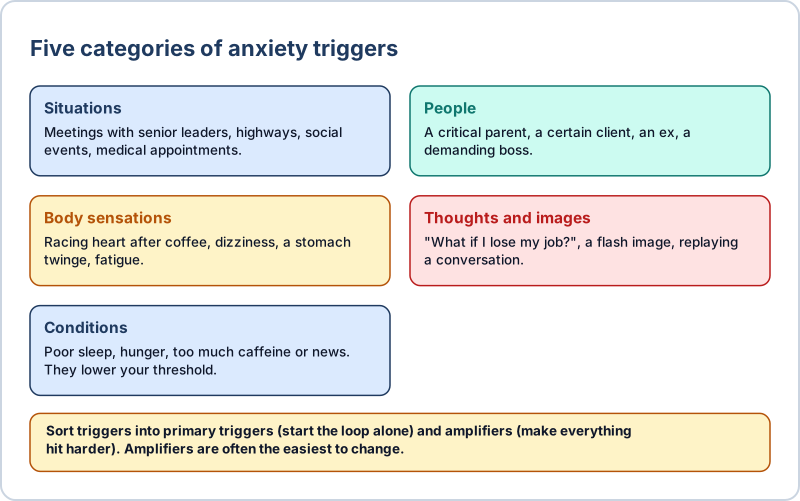
A trigger is anything that reliably starts the loop. Triggers fall into five broad categories:
| Category | Examples |
|---|---|
| Situations | Meetings with senior leaders, driving on highways, social events, medical appointments |
| People | A critical parent, a certain client, an ex, a demanding boss |
| Body sensations | Racing heart after coffee, dizziness, a stomach twinge, fatigue |
| Thoughts and images | “What if I lose my job?”, a flash image of an accident, replaying a conversation |
| Conditions | Poor sleep, hunger, hangovers, too much caffeine, too much news, Sunday evenings |
The last category matters more than most people realize. Conditions don’t cause anxiety by themselves. They lower your threshold, so a normal Tuesday email lands like an emergency. Many people discover that their “work anxiety” is really “work anxiety after five hours of sleep and three coffees.”
Primary triggers and amplifiers
As you map, sort triggers into two types:
- Primary triggers start the loop on their own. For example: “My manager says ‘Can we talk?’”
- Amplifiers make everything else hit harder. For example: sleep under six hours, skipping lunch, or checking the news before 8am.
Amplifiers are often the easiest to change. You may not be able to stop your manager from sending vague messages, but you can move your news check to after lunch.
Themes underneath triggers
Once you’ve listed eight to fifteen triggers, look for the theme underneath them. Common themes include:
- Being judged or found inadequate. This often shows up as performance and social triggers.
- Losing control or being trapped. This often shows up with travel, crowds, and health.
- Something bad happening to people I love. This often shows up as checking and reassurance-seeking.
- Uncertainty itself. Not knowing is the trigger, whatever the topic.
- Physical danger or illness. This often shows up as body-sensation triggers.
Your theme points to which tools will help most. Someone whose theme is uncertainty will get a lot out of Lesson 3.3. Someone whose theme is body sensations will lean on Module 2.
How to map without spiraling
Some people worry that listing triggers will make them more anxious. A few guardrails help:
- Write, don’t ruminate. Put each trigger down in a few words and move on. You’re making an inventory, not reliving anything.
- Rate intensity, not importance. Use a 0–10 scale for how much anxiety each trigger usually brings, where 0 is none and 10 is the most you’ve ever felt.
- Set a timer for 15 minutes. When it goes off, stop.
- End with something steadying. Take a short walk, have a glass of water, or do three long exhales (you’ll learn these properly in Lesson 2.3).
If mapping brings up memories that feel overwhelming, such as trauma, that’s important information, not a failure. Stop the exercise, and consider working through that material with a professional (see Lesson 6.4).
Early warning signs
Along with triggers, map your early warning signs, the first physical, mental, or behavioral signs that the loop has started. For example:
- Physical: tight jaw, shallow breathing, clenched hands, a knot in the stomach
- Mental: “what if” thoughts speeding up, trouble concentrating, rereading the same line
- Behavioral: refreshing email, snacking, snapping at people, going quiet, over-planning
These are your Notice cues. The sooner you notice, the less effort Navigate takes.
Imagine this
Marcus, a founder and father of two, maps his triggers and finds three themes. Investor updates and board meetings trigger judgment. His kids being sick triggers harm to loved ones. And almost everything feels worse on nights he sleeps less than six hours. The amplifier was the surprise. He moves his laptop out of the bedroom, and within two weeks his baseline anxiety noticeably drops, without any change to his board or his kids.
Action Step
Complete Worksheet 1.2: Your Trigger Map (Protocol 2). List triggers in each of the five categories, rate their usual intensity from 0 to 10, and mark each one as a primary trigger or an amplifier. Then circle your top two themes and list your three earliest warning signs.