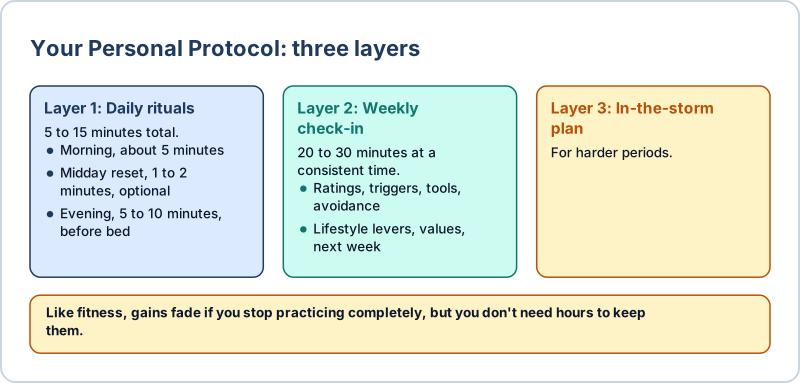
Anxiety management is like physical fitness. The gains fade if you stop practicing completely, but you don’t need to train for hours to keep them. This lesson builds Protocol 12: Your Personal Protocol. It has three layers: a daily rhythm (morning and evening rituals), a weekly check-in, and an in-the-storm plan for harder periods.
Layer 1: Daily rituals
Daily rituals should be short, around 5 to 15 minutes total, so they survive busy weeks.
Morning ritual (about 5 minutes)
Try to do this before checking your phone, or at least before email and news.
- Baseline check (30 seconds): Rate your anxiety from 0 to 10. Notice your body.
- Breath (1 to 2 minutes): Three physiological sighs, or one minute of 4-6 breathing.
- Name today’s likely trigger (30 seconds): “The 2pm budget meeting.”
- Pre-decide one Navigate move (30 seconds): “4-6 breath and feet on the floor before I speak.”
- One values intention (30 seconds): “Today I want to be ___ (patient, present, brave).”
- Light and movement (optional): Two to ten minutes outside or near a window.
Midday reset (1 to 2 minutes, optional)
A quick check: rating, unclench the three, and one somatic reset. Eat lunch.
Worry Window (15 to 20 minutes, late afternoon or early evening)
See Lesson 3.4.
Evening ritual (about 5 to 10 minutes)
Do this 30 to 60 minutes before bed.
- Shutdown (2 minutes): Write tomorrow’s first task. Close work.
- Brain dump (2 to 3 minutes): Write anything still on your mind.
- Three-line review (2 minutes):
- “The hardest moment today was ___.”
- “What helped was ___.”
- “One toward move I made today was ___.”
- Settle (2 to 5 minutes): PMR, long-exhale breathing, or a body scan.
The workbook has a printable card for each of these rituals.
Layer 2: The weekly check-in (20 to 30 minutes)
Pick a consistent time, such as Sunday afternoon (not evening, if Sunday evenings are hard for you) or Friday afternoon. Review:
- Ratings: What was my average rating this week? What were my peaks?
- Triggers: What set me off? Anything new?
- Tools: What helped most? What didn’t?
- Avoidance: Did I avoid anything? What’s my next exposure step?
- Lifestyle levers: How were my sleep, caffeine, alcohol, movement, and food?
- Values: Did I make toward moves? Which area of life needs attention next week?
- Next week: What known stressors are coming up? Write a pre-decided plan for each. Schedule next week’s exposure step and values action.
Layer 3: In-the-storm plan
Some periods are harder: a job change, a family illness, a move, a big launch, a loss, or a difficult season. During these times, your full routine may not be realistic. Decide ahead of time on a minimum viable protocol, the least you’ll do even when everything is chaos:
- Daily minimum: Three physiological sighs morning and night, plus the three-line review.
- Non-negotiables: Consistent wake time, one real meal, a caffeine cutoff.
- Support: Tell one trusted person, “I’m in a hard stretch.”
- Professional check: If a storm lasts more than a couple of weeks, or your ratings stay in the Orange or Red Zone, contact a professional (see Lesson 6.4).
- Permission: “It’s okay that I’m doing less right now. The minimum counts.”
Making the routine stick
- Link to existing habits. Do the morning ritual after brushing your teeth and the weekly check-in with your Sunday coffee.
- Start smaller than you think. A two-minute morning ritual you actually do beats a twenty-minute one you skip.
- Track it for the first month (the tracker is in the workbook).
- Expect imperfection. Missing a day doesn’t mean the routine is broken. Just resume the next day.
Imagine this
Imagine Hannah, an HR director and mother of twins, who builds a three-minute morning ritual that she does while the kettle boils, and a five-minute evening ritual in bed. Her weekly check-in is Friday at 4pm with a cup of tea. When her father is hospitalized, she switches to her storm plan: sighs, the three-line review, a consistent wake time, and a text to her sister. After that month, she goes back to the full routine without feeling she’s “started over.”
Action Step
Complete Worksheet 6.2: My Personal Protocol (with printable Morning and Evening Ritual cards). Design your daily rituals, choose your weekly check-in time and questions, and write your in-the-storm minimum viable protocol. Use the 30-day tracker on the same worksheet for the next month.