So far, most of this course has been about reducing anxiety’s grip. But a life organized around avoiding anxiety is still organized around anxiety. The deeper goal is to build a life organized around what matters to you, with anxiety along for the ride when it shows up.
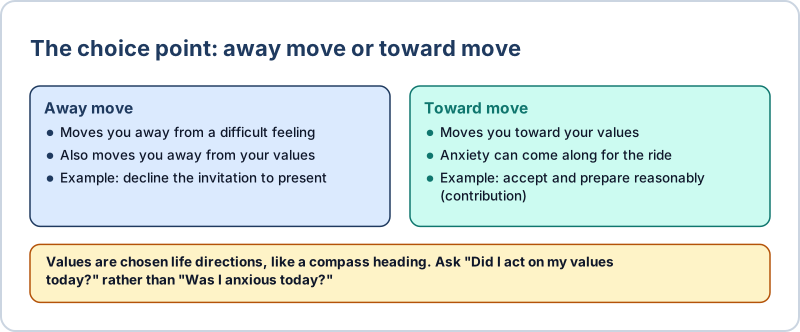
This idea is central to Acceptance and Commitment Therapy (ACT), developed by Steven Hayes and colleagues. In ACT, values are chosen life directions, like a compass heading, not goals you tick off. “Being a present parent” is a value. “Attending every soccer game” is a goal that serves it.
Why values matter for anxiety
- They give you a reason to face discomfort. Exposure (Lesson 5.1) is hard. It’s easier when you know why you’re doing it: “I’m speaking up because I value contributing, not because I’m supposed to.”
- They change the scoreboard. Instead of asking, “Was I anxious today?” (which you can’t fully control), you ask, “Did I act on my values today?” (which you can).
- They reduce the power of avoidance. When you see what avoidance is costing you in the areas you care about, the short-term relief looks less appealing.
Finding your values
Consider these life areas and ask, “What kind of person do I want to be here? What do I want to stand for?”
| Life area | Example values |
|---|---|
| Work and career | Contribution, craft, leadership, integrity, learning |
| Close relationships | Presence, honesty, warmth, reliability |
| Parenting or family | Patience, playfulness, protection, guidance |
| Friendship and community | Loyalty, generosity, connection, service |
| Health and body | Vitality, care, strength |
| Growth and learning | Curiosity, courage, creativity |
| Leisure and play | Adventure, joy, rest |
| Meaning and spirituality | Faith, reflection, gratitude, purpose |
Some prompts to clarify your values:
- “At my 80th birthday, what would I want people to say about how I lived?”
- “If anxiety weren’t a factor, what would I do more of?”
- “What makes me angry or sad when I see it missing in the world? What value does that point to?”
The choice point
A simple ACT-inspired tool: in any moment, you can make a toward move (behavior that moves you toward your values) or an away move (behavior that moves you away from a difficult feeling, but also away from your values).
| Situation | Anxiety says… | Away move | Toward move (value) |
|---|---|---|---|
| Invited to present | “You’ll embarrass yourself.” | Decline | Accept and prepare reasonably (contribution) |
| Child wants a sleepover | “What if something happens?” | Say no | Say yes with a sensible plan (growing their independence) |
| Friend is going through a hard time | “I’ll say the wrong thing.” | Don’t call | Call and say “I’m here” (loyalty) |
| Idea for a side project | “It’ll fail.” | Keep planning forever | Do one small step this week (creativity) |
You can make a toward move while anxious. That’s the whole point. You don’t wait for anxiety to leave before you live. You bring it along.
Committed action: small and specific
Values become real through small, specific, scheduled actions:
- Choose one value in one area of life.
- Choose one small action this week that expresses it.
- Anticipate the anxiety that might show up, and which tool you’ll use.
- Do it, anxious or not.
- Notice how it felt to act on your values.
Example: “Value: presence with my kids. Action: 30 minutes of phone-free play on Tuesday and Thursday after dinner. Likely anxiety: ‘I’m falling behind on email.’ Tool: park it for the Worry Window, and do a 4-6 breath.”
Imagine this
Imagine Grace, a lawyer, who has turned down every speaking invitation for five years. When she does the values exercise, “contribution” and “mentoring young lawyers” come out on top. She realizes her avoidance has cost her exactly the things she cares about most. She accepts a 15-minute talk at a law school. She’s anxious, uses her toolkit, and gets through it with her hands shaking a little. Afterward, three students ask for coffee. She writes: “Anxious and aligned beats calm and absent.”
Action Step
Complete Worksheet 6.1: My Values Compass. Rate how important each life area is to you and how consistently you’ve been acting on it lately. Write one or two core values for your top three areas. List your common away moves and the toward moves you could make instead. Commit to one small values-based action this week and schedule it.