Relationships are where anxiety can feel most personal. Worry about a partner’s feelings, a friend’s silence, a child’s safety, or a parent’s health can take over. And one of the most natural responses, asking for reassurance, often keeps the anxiety going.
Common relationship anxiety patterns
- Reading into silence or tone: “She hasn’t texted back, so she’s upset with me.”
- Fear of rejection or abandonment: Needing frequent confirmation that the relationship is okay.
- Worry for loved ones: Catastrophic thoughts about kids, partners, or parents being harmed or sick.
- Conflict avoidance: Swallowing needs to keep the peace, then resenting it.
- People-pleasing: Saying yes to avoid disappointing anyone.
The reassurance trap
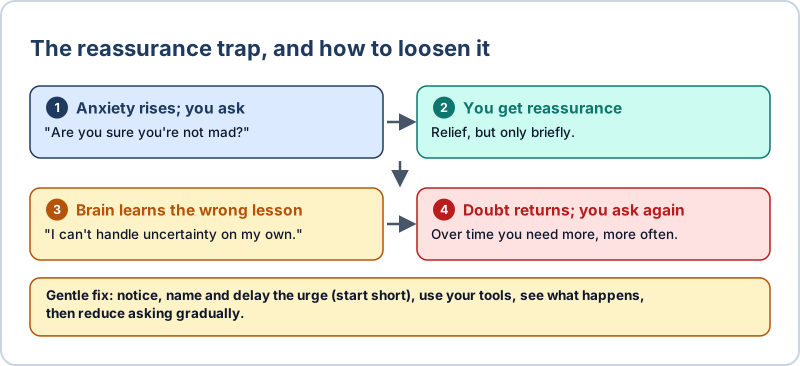
Reassurance seeking means repeatedly asking others (or googling, or checking) to reduce your anxiety. For example: “Are you sure you’re not mad?” “Do you still love me?” “Does this look like a normal mole?” “Did I say something weird at dinner?”
It’s completely human. The problem is how it works over time:
- Anxiety rises. You ask.
- You get reassurance. You feel relief, briefly.
- Your brain learns, “I can’t handle this uncertainty on my own. I need someone else to settle it.”
- The relief fades, doubt comes back (often with a “but what if they’re just saying that?”), and you ask again.
Over time, you need more reassurance, more often. It can also strain relationships, because loved ones can feel worn out, or feel that nothing they say is enough.
Reducing reassurance seeking, gently
This is another type of Uncertainty Rep (Lesson 3.3).
- Notice the urge. “I want to ask if she’s mad.”
- Name it. “That’s the reassurance urge.”
- Delay it. “I’ll wait 30 minutes.” (Start with a short delay and build up.)
- Use your tools during the delay: the Four-Question Check, grounding, or getting absorbed in a task.
- Notice what happens. The urge often fades on its own.
- Gradually reduce how often you ask. Don’t try to stop all at once.
Talk to your people about it. If a partner or friend usually provides the reassurance, you can enlist their help: “I’m working on not asking for reassurance so much. If I ask the same thing twice, could you gently say, ‘I think that’s the anxiety asking’? And maybe give me a hug instead.” Loved ones often feel relieved to have a clear, kind way to respond.
Clear communication beats mind-reading
Mind-reading (Lesson 3.1) is at the heart of much relationship anxiety. The alternative is one clear question, asked once, followed by trusting the answer:
- Instead of: Rereading texts for tone and asking “Are you mad?” five times.
- Try: “You seemed quiet at dinner. Is anything up?” And then believe the answer.
If they say “I’m just tired,” take it at face value. If a doubt comes back, treat it as an Uncertainty Rep.
Worry for loved ones
Worry about the people you love, especially children and aging parents, is deeply natural and can easily become excessive. Tools:
- The Worry Sort: Is there a reasonable, concrete step (a checkup, a conversation, a safety measure)? If so, take it. If not, it’s a spiral.
- Recognize the “worry = love” belief. Many people feel that worrying is caring, or that stopping would make harm more likely. Worry doesn’t protect anyone. Presence, preparation, and connection do.
- Watch for checking: constant location checks, repeated calls, and scanning news for danger are certainty-seeking behaviors. Reduce them gradually.
Conflict and people-pleasing
If avoiding conflict is your pattern, use an Exposure Ladder (Lesson 5.1) for assertiveness. Start small, like returning an order that’s wrong or stating a restaurant preference, and build up to harder steps, like saying no to a family request or raising an issue with your partner.
A simple assertiveness framework:
“When ___ happens, I feel . What I’d like is . Would that work for you?”
Imagine this
Imagine Laura, who texts her partner several times a day to check whether he’s annoyed with her. They agree on a plan. When she asks a second time, he’ll say, “That’s the anxiety. I’m good,” and change the subject. She practices delaying the urge by 30 minutes and running the quick check (“Evidence? He said he’s fine. Most likely? He’s busy.”). Over a month, her check-in texts drop to roughly one a day, and both of them say the relationship feels more relaxed.
Action Step
Complete Worksheet 5.3: My Reassurance and Relationship Log. For one week, log each reassurance urge, whether you acted on it or delayed it, and what happened. Write your script for enlisting a loved one, and plan one assertiveness step from the worksheet’s ladder.