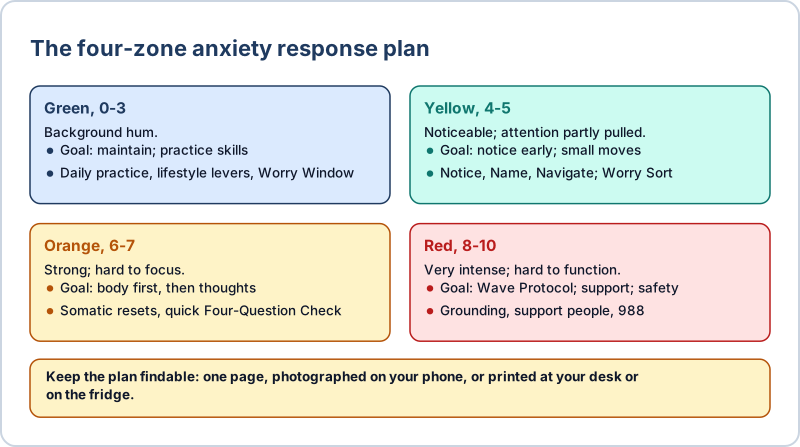
Now you pull your tools into one document: a personal plan for handling anxiety at every intensity. It’s based on what you’ve tested, not on generic advice. When you’re anxious, you don’t want to be deciding what to do. You want to be looking it up.
The zone system
Your plan is organized into four zones, based on your 0–10 rating:
| Zone | Rating | What it looks like | Goal |
|---|---|---|---|
| Green | 0–3 | Background hum; functioning well | Maintain; practice skills |
| Yellow | 4–5 | Noticeable; attention partly pulled | Notice early; small moves; keep going |
| Orange | 6–7 | Strong; hard to focus; urge to escape | Body first, then thoughts; stay if possible |
| Red | 8–10 | Very intense; hard to function | Wave Protocol; support; safety |
What goes in each zone
Green Zone: maintenance – Your daily practice (for example, 5 minutes of breathing and one Uncertainty Rep) – Lifestyle levers you’re keeping (for example, caffeine cutoff at noon) – Your Worry Window time
Yellow Zone: early moves – Your personal early warning signs (from Worksheet 1.2) – Notice, Name, Navigate – Your top two Tier 1 real-time tools – The Worry Sort
Orange Zone: active management – Body first: your top two or three somatic resets – Then thoughts: the quick Four-Question Check – The Spiral Interruption Guide if you’re looping – A pause script if you’re with people – A way to finish the stress cycle afterward (movement, a call)
Red Zone: ride the wave and get support – The Wave Protocol – Your go-to grounding technique – Names and numbers of your three support people – 988 and your local emergency number – A reminder: “When this passes, I’ll ___ (rest, eat, tell my therapist).”
Situation-specific add-ons
Some situations deserve their own mini-plan. Common ones are:
- Before a known stressor (a big meeting, a flight, a medical appointment): Prep the night before. Use your Tier 1 move during it and a stress-cycle finisher afterward.
- Sunday evening: Do your Worry Window earlier in the day, plan Monday’s first task, and go for a walk.
- Middle of the night: Use the tools in Lesson 5.4.
- After a setback: See Lesson 6.3.
Make it findable
A plan in a drawer doesn’t help. Keep it:
- One page (the worksheet is designed to fit on one printed page)
- Photographed and saved as a favorite on your phone
- Printed at your desk or on the fridge
- Shared, if you’d like, with a partner or close friend, so they know what helps you
Review and revise
Your plan is a living document. Review it:
- Weekly for the first month (as part of your routine in Lesson 6.2)
- Monthly after that
- After any Red Zone episode: What helped? What didn’t? What would I change?
Imagine this
Kwame, a hospital administrator and father of two, writes his plan. His Yellow Zone warning sign is re-reading emails. His move there is a 4-6 breath and the Worry Sort. In the Orange Zone he goes to the stairwell for three flights and then runs the quick check. In the Red Zone he uses the Wave Protocol and texts his brother. He keeps it on his phone’s lock screen for the first month. Two weeks in, during a tense budget meeting, he catches himself in the Yellow Zone and looks at his lock screen. The meeting stays tense, but he doesn’t.
Action Step
Complete Worksheet 4.5: My Personalized Anxiety Response Plan (a one-page template). Fill in each zone with tools you’ve tested, add your early warning signs and support contacts, and write at least two situation-specific add-ons. Photograph it, print it, and put it somewhere you’ll see it daily.