If you’re in crisis or thinking about harming yourself, call or text 988 (US) or your local emergency number. The 988 Suicide & Crisis Lifeline is free and confidential, and it’s available 24/7 by call, text, or chat. You don’t have to be suicidal to reach out. You can also contact them if you’re in overwhelming emotional distress.
This lesson is educational. It’s not a treatment for panic attacks or panic disorder. If you have panic attacks, especially recurring ones, please work with a licensed clinician. Structured therapy approaches for panic are well established, and a professional can tailor them to you. Please read this lesson alongside Lesson 6.4.
What a panic attack is
A panic attack is a sudden surge of intense fear or discomfort. It typically peaks within minutes and comes with strong physical sensations, such as:
- Pounding or racing heart
- Shortness of breath or a feeling of smothering
- Chest tightness
- Dizziness or lightheadedness
- Tingling or numbness
- Trembling, sweating, hot or cold flashes
- Nausea
- Feeling unreal or detached
- Fear of losing control, “going crazy,” or dying
A panic attack is the same alarm system from Module 2, firing at full intensity. The sensations are extremely uncomfortable and often terrifying, but in a healthy body they are not dangerous in themselves.
Important: Many panic symptoms overlap with medical emergencies, such as heart problems. If you have chest pain, trouble breathing, or symptoms you’ve never had before, or if you have any doubt, seek emergency medical care. Get new symptoms checked by a doctor rather than assuming they’re anxiety.
Why panic escalates
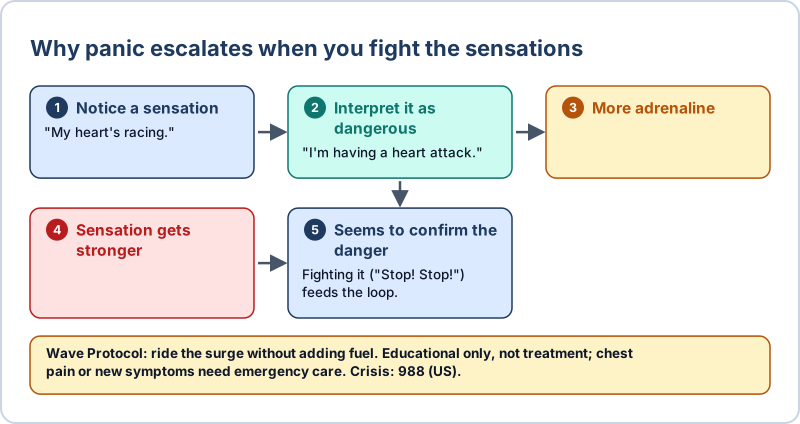
Panic often escalates through a feedback loop. You notice a sensation (“My heart’s racing”), interpret it as dangerous (“I’m having a heart attack”), which triggers more adrenaline, which makes the sensation stronger, which seems to confirm the danger. Fighting the sensations (“Stop! Stop!”) tends to feed the loop. The approach below works by not fighting the wave.
Protocol 10: The Wave Protocol
Think of the surge as a wave. It rises, peaks, and falls. Your job isn’t to stop it. Your job is to ride it without adding more fuel.
W — Watch and name it. “This is a surge of panic. It’s my alarm system. It’s very uncomfortable, and it will peak and pass.”
A — Allow the sensations. Instead of fighting, let them be there. “My heart is racing. I can let it race. My chest is tight. I can let it be tight.” It sounds backwards, but dropping the fight often takes away some of the fuel.
V — Very slow exhales. Gently lengthen your exhale: 4 in, 6 to 8 out. Don’t gulp big breaths. If breathing focus makes things worse, switch to grounding (feet on the floor, 5-4-3-2-1 out loud) or cold water on your face.
E — Expect it to pass, and stay if you can. Surges typically peak within minutes and then begin to ease. Remind yourself: “It’s already peaking. It’s going to pass.” If it’s safe, stay where you are instead of fleeing. Staying teaches your brain the situation wasn’t dangerous. If you do need to leave, that’s okay. There’s no failure here.
Afterward: Expect to feel tired, shaky, or drained. That’s normal after an adrenaline surge. Drink water, eat something, move gently, and be kind to yourself. Later, when you’re calm, note what happened on your worksheet.
When other hard feelings hit
Not every overwhelming moment is panic. Sometimes it’s a wave of grief, shame, dread, despair, or loneliness that feels too big. The same principles apply:
- Name it (“This is grief,” or “This is shame”).
- Allow it without judging yourself for having it.
- Ground and breathe to lower the intensity enough to function.
- Reach out. Call or text someone you trust. You don’t have to explain everything. “Can you talk for ten minutes? I’m having a hard night” is enough.
- Get professional help if the feelings are frequent, lasting, or getting worse.
Seek help right away (988, your local emergency number, or an emergency room) if you:
- Have thoughts of harming yourself or ending your life
- Feel unable to keep yourself safe
- Feel hopeless or like a burden to others
- Are experiencing something that feels like a medical emergency
Reaching out is a strong, skillful move, not a failure of the tools in this course.
Imagine this
Mia, an accountant, feels a sudden surge of dread and a racing heart in the grocery store. She’s had these before and has already been checked by her doctor, and she’s now working with a therapist. She uses the Wave Protocol. She names it (“Panic surge. My alarm.”), allows the racing heart, slows her exhale, and holds on to the cart while watching the clock. At 3 minutes it peaks. By 8 minutes it’s a 4. She finishes shopping slowly. That evening she tells her therapist about it, and together they add it to the plan they’re working on.
Action Step
Complete Worksheet 4.4: My Wave Protocol and Support Card. Write out the Wave Protocol in your own words, list three people you can reach out to when a hard moment hits, and note the 988 number and your local emergency number. Cut out the card and keep it in your wallet and as a photo on your phone. If you have panic attacks, check the “talk to a professional” box on the worksheet and schedule that conversation.