Progressive Muscle Relaxation (PMR) was developed by American physician Edmund Jacobson, who described it in his 1929 book Progressive Relaxation. The idea is simple: when you deliberately tense a muscle group and then release it, you notice the contrast, and the release tends to be deeper than if you tried to “just relax.” PMR is one of the most studied relaxation methods and is widely used in stress-management programs.
It’s especially useful for people who carry anxiety as physical tension, like a tight jaw, raised shoulders, a clenched stomach, or restless legs, and for people who have trouble falling asleep.
Before you start
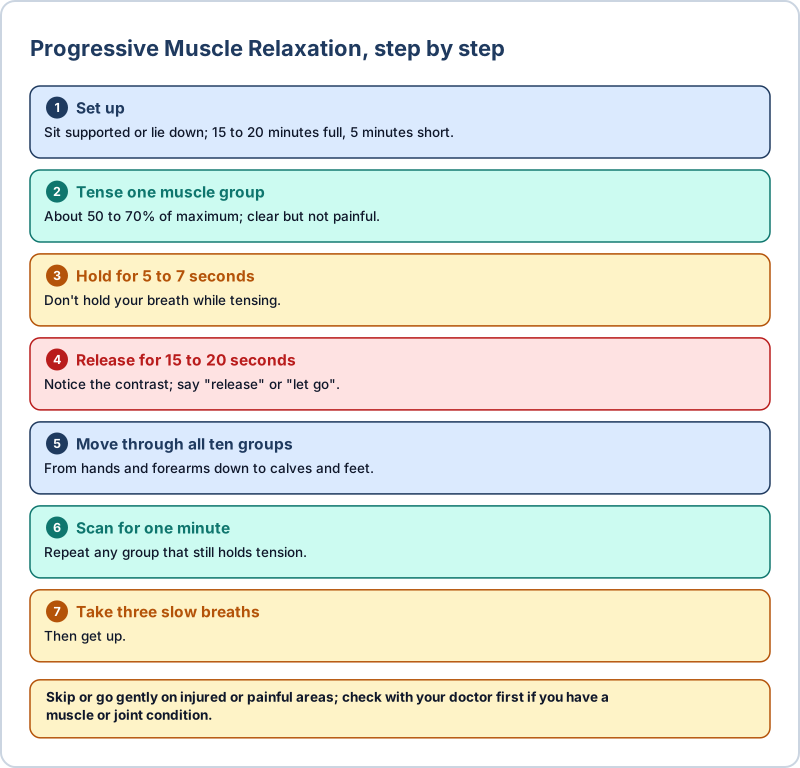
- Time: 15 to 20 minutes for the full version, 5 minutes for the short version.
- Position: Sitting in a supportive chair or lying down.
- Tension level: About 50 to 70% of your maximum. You want to feel it clearly, but it shouldn’t hurt.
- Caution: Skip or go very gently with any area that’s injured or painful. If you have a medical condition affecting your muscles or joints, check with your doctor first. Don’t hold your breath while tensing.
The full version (16 muscle groups, simplified to 10)
For each group: tense for 5 to 7 seconds, then release and relax for 15 to 20 seconds. As you release, notice the difference between tension and relaxation. You might silently say “release” or “let go.”
- Hands and forearms. Make tight fists. Release.
- Upper arms. Bend your elbows and tense your biceps, like showing off a muscle. Release and let your arms drop.
- Forehead. Raise your eyebrows high. Release.
- Eyes and cheeks. Squeeze your eyes shut. Release.
- Jaw and mouth. Clench your teeth gently and pull the corners of your mouth back. Release and let your jaw hang slightly open.
- Neck and shoulders. Shrug your shoulders up toward your ears. Release and let them drop.
- Chest and upper back. Take a breath and squeeze your shoulder blades together. Release as you exhale.
- Stomach. Tighten your stomach muscles as if bracing for a light poke. Release.
- Thighs and buttocks. Squeeze your thighs and glutes together. Release.
- Calves and feet. Point your toes away from you, then flex them back toward you. Release.
After all ten, spend one minute scanning your body. If you find any leftover tension, repeat that group. Then take three slow breaths before getting up.
The short version (5 minutes)
Combine groups into four:
- Arms and hands (fists and biceps together)
- Face, jaw, neck, and shoulders
- Chest, stomach, and back
- Legs and feet
Tense each for 5 seconds, then release for 15 to 20 seconds. Repeat the whole sequence twice.
The micro version (under 1 minute, discreet)
- Clench your fists and curl your toes inside your shoes for 5 seconds. Release for 10 seconds. Repeat three times.
- Or: shrug your shoulders to your ears for 5 seconds, then drop them. Repeat three times.
This is somatic tool #7 from Lesson 2.4 and works well in the Real-Time Toolkit.
Building the skill: the release-only goal
Over several weeks of regular practice, the aim is to recognize tension earlier and to release it without tensing first. Jacobson’s original method was designed to develop this kind of fine awareness of muscle tension. A practical progression:
- Weeks 1–2: Full version daily (or the short version if you’re pressed for time).
- Weeks 3–4: Short version daily, and the micro version whenever you notice tension.
- Week 5 and beyond: “Release-only.” Scan your body, notice a tense area, and let it go without tensing first. Use PMR as a bedtime or weekly reset.
Troubleshooting
| Problem | Fix |
|---|---|
| “I can’t relax, I just feel more aware of tension.” | Normal at first. Awareness comes before release. Keep going for two weeks. |
| “My mind wanders.” | Expected. Just return to the next muscle group. The structure helps. |
| “I fall asleep.” | Great at bedtime. For daytime practice, do it sitting up. |
| “I get a cramp.” | You’re tensing too hard. Use 50% effort, and skip the feet if they’re prone to cramping. |
| “Relaxing makes me more anxious.” | Some people feel uneasy as they relax. Keep your eyes open, use the short version, and remind yourself the feeling will pass as it becomes familiar. |
Imagine this
Tom, a project manager, wakes every morning with a sore jaw and gets tension headaches by afternoon. He starts doing the full PMR before bed. After two weeks he notices he’s catching jaw clenching during the day, at his desk, in traffic, and in meetings, and releasing it. The headaches become less frequent. He isn’t calm all the time, but his body no longer holds on to every stressful moment.
Action Step
Use Worksheet 4.3: The PMR Practice Log. Do the full or short version daily for two weeks, rating your tension from 0 to 10 before and after each session. Note which muscle groups hold the most tension for you, and add the micro version to your Real-Time Toolkit Cards.