Most anxiety advice assumes you can step away, lie down, or go for a long walk. Real life rarely allows that. Anxiety hits at 2pm on a Tuesday, when you’re mid-meeting, mid-decision, or mid-bedtime routine with a toddler. This lesson gives you a toolkit you can use without anyone noticing.
Protocol 9: The Real-Time Toolkit
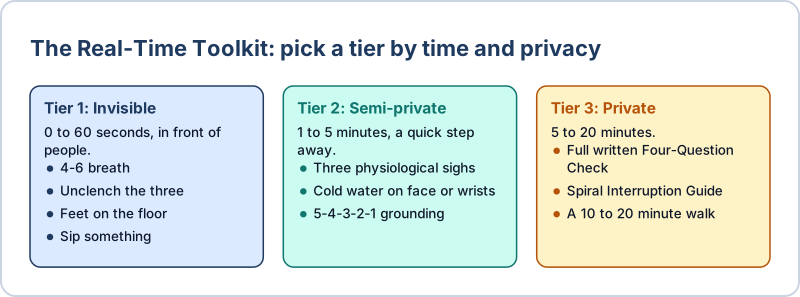
The toolkit is organized by how much time and privacy you have.
Tier 1: Invisible (0 to 60 seconds, in front of people)
These work in a meeting, on a video call, at a dinner table, or on stage.
- The 4-6 breath. Inhale for 4, exhale for 6, through your nose. No one can tell.
- Unclench the three. Drop your jaw, drop your shoulders, and soften your hands.
- Feet on the floor. Press your feet down and feel the chair supporting you.
- Name it silently. “Anxiety loop, triggered by ___. It’ll peak and pass.”
- Relabel. “This is energy for the task,” or “My body is getting ready.”
- Anchor your eyes. Rest your gaze on one neutral object, like a pen or a coffee cup, and notice its details for three breaths.
- Hand press. Press your fingertips together firmly under the table, or press your palms against your thighs, for five seconds. Then release.
- Sip something. Taking a slow sip of water naturally slows your breathing and buys you a moment.
Tier 2: Semi-private (1 to 5 minutes, a quick step away)
These work in a bathroom, hallway, car, or stairwell, or when you’re “grabbing a coffee.”
- Three physiological sighs.
- Cold water on your face or wrists.
- Shake out your hands and arms for 30 seconds.
- The quick Four-Question Check (Lesson 3.2), in your head or in a note on your phone.
- A brisk walk up and down the stairs.
- 5-4-3-2-1 grounding (Lesson 4.2).
Tier 3: Private (5 to 20 minutes)
These work between meetings, at lunch, or after the kids are in bed.
- The full written Four-Question Check.
- The Spiral Interruption Guide (Lesson 3.4).
- Short progressive muscle relaxation (Lesson 4.3).
- A 10 to 20 minute walk, ideally outside.
- A call with a steadying person.
Scripts for when you need a moment
Sometimes the best move is a brief, graceful pause. Have a few lines ready:
- “Let me think about that for a second.” (Buys 5 to 10 seconds for a breath.)
- “Good question. Let me make sure I answer that properly.” (Buys time and sounds thoughtful.)
- “Can we take five? I want to grab some water.” (A reasonable request in most meetings over an hour.)
- “I’ll follow up with details by end of day.” (Takes the pressure off answering on the spot.)
- “I need to step out for a minute. Go ahead without me.” (For a quick Tier 2 reset.)
None of these reveal that you’re anxious, and they’re all normal professional behavior. Confident, composed people use them all the time.
Staying in the room
Here’s an important principle: the best real-time tool usually lets you stay in the situation, not escape it. Tier 1 tools help you ride the wave while you keep doing what you were doing. If you always leave when anxiety rises, you teach your brain the situation was dangerous (see Lesson 5.1). Use Tier 2 and 3 tools when you truly need them, but aim to get more and more of your real-time management done with Tier 1 while staying put.
Choosing your moves in advance
Remember from Notice, Name, Navigate that anxious brains are bad at designing plans on the fly. Before your known high-stress situations, decide:
- My Tier 1 move: ___
- My Tier 2 move, if needed: ___
- My script, if I need a pause: ___
Imagine Chris, a consultant who dreads the Monday client stand-up. His plan: a 4-6 breath and feet on the floor when he’s about to speak. If his anxiety goes over 7, he’ll say “Let me pull that number and follow up.” After the meeting, he’ll take a five-minute walk. Having it decided in advance means he’s not scrambling in the moment. Over a month, the stand-up goes from dreaded to mildly annoying.
Printable toolkit cards
The workbook includes printable Real-Time Toolkit Cards: one for each tier, plus a card with your scripts. Keep a photo of them on your phone and a paper copy in your wallet or desk. They’re there when your thinking brain isn’t.
Action Step
Complete Worksheet 4.1: My Real-Time Toolkit Cards. Choose your top three Tier 1 moves, your top two Tier 2 moves, and your top two Tier 3 moves, based on what you’ve tested in Modules 2 and 3. Write two pause scripts in your own words. Then fill in a pre-decided plan for your three most common high-stress situations.