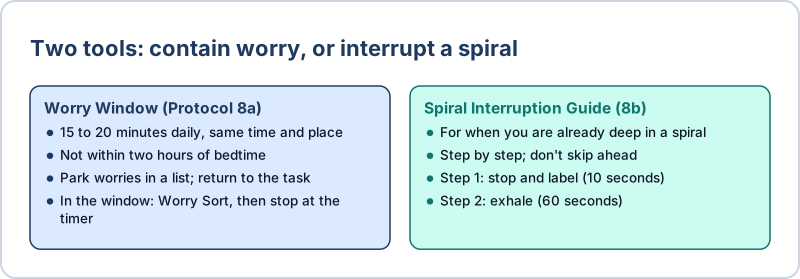
Anxious worry tends to leak into every part of your day, like meetings, dinners, and bedtime. This lesson gives you two protocols. The Worry Window contains worry to a set time. The Spiral Interruption Guide gives you a step-by-step way out of a spiral when it’s already underway.
Protocol 8a: The Worry Window
Worry postponement, sometimes called stimulus control for worry, was studied by Thomas Borkovec and colleagues in the early 1980s. They found that setting aside a specific time and place for worrying, and postponing worry to that window during the rest of the day, reduced time spent worrying. The idea is simple: you don’t ban worry, you schedule it.
Setting it up:
- Choose a time. 15 to 20 minutes a day, at the same time each day. Not within two hours of bedtime. Late afternoon or early evening works well for most people.
- Choose a place. Somewhere other than your bed or where you relax. A specific chair or desk.
- Keep a “worry parking lot.” Use a notes app or a small notebook.
During the day:
- When a worry shows up, Notice and Name it: “That’s a worry.”
- Write it in the parking lot in a few words.
- Tell yourself: “I’ll think about this at 5:30.”
- Gently bring your attention back to what you’re doing. The worry will come back. Park it again. Returning to the task is the skill.
During the window:
- Read your parking lot list. Many worries will already feel less urgent or will have resolved themselves. Cross those off.
- For the rest, run the Worry Sort (Lesson 1.3). Turn productive worries into next actions.
- For spirals, use the Four-Question Check (Lesson 3.2) or simply practice the uncertainty phrase: “I don’t know, and I can live with that.”
- When the timer ends, stop. Do something that marks a transition, like a walk, cooking, or a shower.
Some people find it strange at first to worry on purpose. After a week or two, most notice that worries feel more manageable because they know there’s a set time for them.
Protocol 8b: The Spiral Interruption Guide
Sometimes you’re already deep in a spiral. It’s 11pm, or mid-commute, or during a quiet afternoon, and you’re three layers into “what if.” Use this guide, step by step. Don’t skip ahead.
Step 1: Stop and label (10 seconds). Say silently or out loud: “I’m in a spiral. This is my mind, not the situation.” This brings Notice and Name into the moment.
Step 2: Exhale (60 seconds). Do three physiological sighs or one minute of 4-6 breathing. This lowers the physical intensity so your thinking brain can help.
Step 3: Sort (30 seconds). Ask: “Is there a real problem here I can act on in the next 24 hours?” – Yes: Write down the next action and when you’ll do it. Go to step 5. – No: Go to step 4.
Step 4: Postpone or accept (30 seconds). Choose one: – Postpone: Write it in the worry parking lot for your next Worry Window. – Accept: “Maybe, maybe not. I don’t know, and I can live with not knowing.”
Step 5: Redirect (2 to 10 minutes). Put your attention into something absorbing and physical or sensory. You can walk, cook, tidy, or talk to someone about something else. At night, use the tools in Lesson 5.4. Don’t pick something passive, like scrolling, because the mind will go straight back to the spiral.
Step 6: Expect return, and repeat kindly. The spiral may come back in ten minutes. That’s normal. Repeat from step 1, more briefly. Every time you step out of the spiral, you’re strengthening the skill, even if it takes several tries.
What the guide isn’t for
The Spiral Interruption Guide is for everyday worry spirals. If spirals are taking up hours of your day, if they involve disturbing, unwanted thoughts that you feel compelled to neutralize, or if your worry comes with hopelessness or thoughts of harming yourself, that’s a sign to get professional support (see Lesson 6.4). If you’re in crisis or thinking about harming yourself, call or text 988 (US) or your local emergency number.
Imagine this
Elena, a small-business owner, spends every evening spiraling about cash flow. She sets a Worry Window for 5:30 to 5:50pm at her kitchen table. During the day she parks worries in her phone. At 5:30 she sorts them. Two become actions (call the accountant, send overdue invoices), three she crosses off, and one (“What if the business fails in five years?”) she answers with “Maybe, maybe not. I’m taking the right steps today.” When that same worry comes back at 10pm, she runs the Spiral Interruption Guide. She labels it, sighs, sees that it’s already parked, and redirects to reading. It comes back twice more, more weakly each time.
Action Step
Complete Worksheet 3.4: My Worry Window Setup and Spiral Interruption Guide. Choose your window’s time and place, set up your parking lot, and run the Worry Window every day for two weeks, using the log on the worksheet. Cut out the Spiral Interruption Guide card and keep it by your bed or in your wallet.