For many anxious people, the core problem isn’t any specific fear. It’s not knowing. The test result, the reorg announcement, the text that hasn’t been answered. Researchers Michel Dugas, Robert Ladouceur, and colleagues have studied this as intolerance of uncertainty, a tendency to find uncertainty stressful and to feel you must eliminate it. It’s closely linked to chronic worry.
The key insight is that you can’t eliminate uncertainty from life, but you can become more tolerant of it. That tolerance is a skill, and like any skill, it improves with practice.
How intolerance of uncertainty works
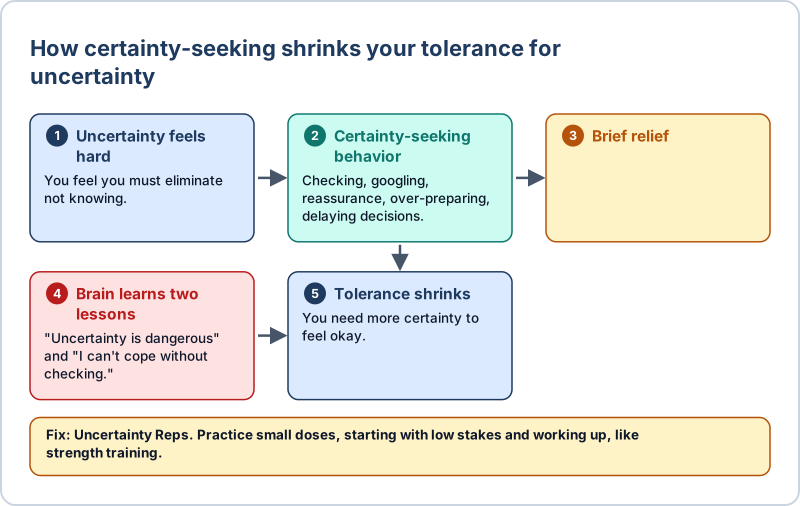
When uncertainty is hard for you, you try to get rid of it with certainty-seeking behaviors:
- Checking (email, bank accounts, locks, your body)
- Googling and researching far beyond what’s useful
- Asking for reassurance (“Are you sure it’s fine?”)
- Over-preparing and over-planning
- Refusing to delegate
- Putting off decisions until you’re “sure”
- Avoiding new or unpredictable situations
Each behavior brings brief relief. But it also teaches your brain two lessons: “Uncertainty is dangerous” and “I can’t cope without checking.” Over time your tolerance shrinks, and you need more certainty to feel okay.
The shift: from “I need to know” to “I can live with not knowing”
Thought work (Lesson 3.2) asks, “Is this thought accurate?” Uncertainty work asks something different: “Can I tolerate not knowing, and act anyway?” This comes partly from Acceptance and Commitment Therapy (ACT), developed by psychologist Steven Hayes and colleagues. ACT focuses less on changing the content of thoughts and more on changing your relationship with them.
Some useful phrases:
- “I don’t know, and I can live with not knowing.”
- “Maybe, maybe not.”
- “This is the feeling of uncertainty. It’s uncomfortable, not dangerous.”
- “I’ll deal with it if and when it happens.”
Protocol 7: Uncertainty Reps
You build tolerance by deliberately practicing small doses of uncertainty, starting easy and gradually working up. Think of it as strength training.
Level 1: Low stakes
- Order something new at a restaurant without reading the reviews.
- Send a routine email without rereading it.
- Take a new route to work without a map app.
- Watch a movie without looking up the plot or ratings.
- Leave your phone in another room for an hour.
Level 2: Medium stakes
- Delegate a task and don’t check on it until the deadline.
- Make a small decision (under $100, a weekend plan) in five minutes, not fifty.
- Let a text go unanswered for a few hours without checking whether it’s been read.
- Share a draft that’s “good enough” instead of polished.
Level 3: Higher stakes
- Hold off on googling a minor symptom and wait for your scheduled appointment instead.
- Make a work decision with 80% of the information.
- Accept an invitation to something unfamiliar.
How to do a rep:
- Choose the rep and predict how anxious you’ll get (0–10) and what you think will happen.
- Do it. Don’t use a safety behavior like checking or asking for reassurance.
- Notice the discomfort. Label it: “This is uncertainty.”
- Afterward, write down what actually happened and how anxious you actually got.
- Ask: “What did I learn about my ability to handle not knowing?”
Most people find that the anxiety is lower than predicted, and that it passes faster than expected. They also usually find that the bad outcome didn’t happen, or that when something did go a bit wrong, they handled it.
Acceptance isn’t resignation
Tolerating uncertainty doesn’t mean not caring or not preparing. You can prepare reasonably for the presentation, get reasonable medical care, and make reasonable plans. The difference is that you stop at “reasonable” instead of chasing “certain.” A useful test: “Is this action making the outcome better, or just making me feel more certain?”
Imagine this
Ben, a finance manager, checks his work email about forty times a day, including nights and weekends, “in case something blows up.” He starts with Level 1 reps, like not checking during dinner. His predicted anxiety is 7, and his actual anxiety is 5, then 3 after twenty minutes. Nothing blows up. Two weeks later he’s checking at set times only: 9am, noon, 3pm, and 5pm. He finds that urgent matters reach him by phone anyway. His evenings feel noticeably quieter.
Action Step
Complete Worksheet 3.3: The Uncertainty Reps Ladder. List your certainty-seeking behaviors. Then build a ladder of ten reps from Level 1 to Level 3, tailored to your life. Do at least one rep a day for two weeks and log your predicted and actual outcomes.