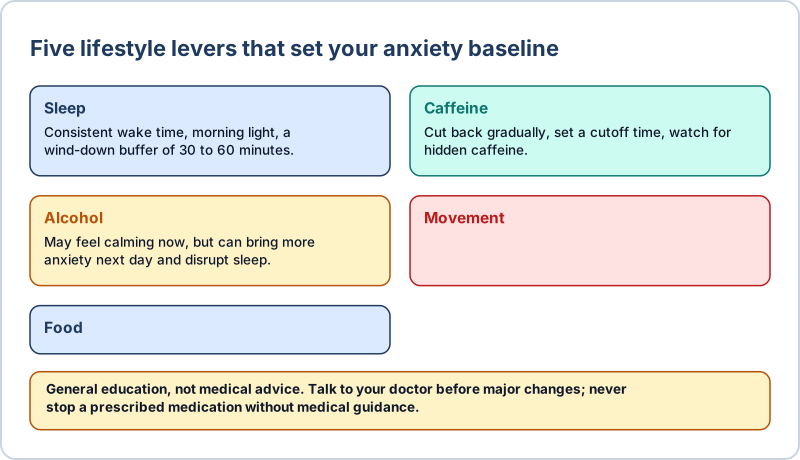
Your daily conditions set your baseline, which is the resting level your alarm system starts from each day. If your baseline is a 2, a stressful email pushes you to a 5. If it’s a 5, the same email pushes you to an 8. You’ll get the most out of every other tool in this course by making small, sustainable adjustments to five lifestyle levers.
This lesson is general education, not medical advice. Talk to your doctor before making major changes to diet, exercise, alcohol, or any medication, and never stop a prescribed medication without medical guidance.
Lever 1: Sleep
Sleep and anxiety feed each other. Anxiety makes sleep harder, and poor sleep lowers your threshold for anxiety the next day. Basic sleep supports:
- A consistent wake time, even on weekends. This is the most powerful anchor for your body clock.
- Morning light. Get outdoor light within an hour or so of waking, even on a cloudy day.
- A wind-down buffer. Set aside 30 to 60 minutes before bed with dimmer lights and no work email.
- A cool, dark, quiet bedroom.
You’ll find specific tools for an anxious mind at bedtime in Lesson 5.4.
Lever 2: Caffeine
Caffeine is a stimulant. It produces physical sensations like a faster heart rate, jitteriness, and restlessness that overlap heavily with anxiety. In people prone to anxiety, those sensations can be misread as anxiety and kick off the loop. Caffeine also lingers in the body for hours, so afternoon coffee can affect your sleep.
Practical experiments:
- Cut back gradually. Stopping suddenly can cause headaches and irritability.
- Set a cutoff time, such as no caffeine after noon or 1pm.
- Watch for hidden caffeine in tea, soda, energy drinks, pre-workout supplements, and some pain relievers.
- Eat before your first coffee, especially if mornings are hard.
Check your week-one tracker (Worksheet 1.4). Do your spikes line up with caffeine?
Lever 3: Alcohol
Alcohol can feel like it lowers anxiety in the moment, which is exactly what makes it tricky. Many people notice more anxiety the next day, sometimes called “hangxiety.” Alcohol also disrupts sleep later in the night. If alcohol has become your main way to come down after a hard day, it’s worth experimenting with other ways to finish the stress cycle (Lesson 2.2).
If you find it hard to cut back, or you drink to manage anxiety most days, please talk to a doctor. That’s exactly the kind of pattern where professional support helps. Stopping heavy, regular drinking suddenly can be medically risky, so get medical advice first.
Lever 4: Movement
Regular physical activity is one of the most consistently recommended lifestyle supports for mood and anxiety in the research literature. Movement also gives you a regular way to finish the stress cycle. You don’t need an intense program:
- Daily walking, ideally outdoors.
- Something that raises your heart rate a few times a week. There’s a bonus here: it teaches your brain that a pounding heart can be safe, which helps if your anxiety is sensitive to body sensations.
- Movement snacks. Two to five minutes of stairs, stretches, or squats between meetings.
Lever 5: Food, water, and blood sugar
Skipping meals and running on caffeine can produce shakiness, irritability, and lightheadedness, which feel a lot like anxiety. Simple supports:
- Regular meals, including protein and fiber, especially breakfast and lunch on busy days.
- Water through the day.
- A snack before high-stakes events if you tend to skip meals under pressure.
Other levers worth a look
- News and social media. Set specific times to check instead of scrolling all day. Consider keeping them out of the first and last hour of your day.
- Screens in the bedroom. Charge your phone outside the bedroom if you can.
- Connection. Regular, warm contact with people you trust is protective. Isolation tends to amplify anxiety.
- Nature and daylight. Time outside is a low-effort way to lower your baseline.
Change one thing at a time
You’ll be tempted to overhaul everything at once. Don’t. Pick one lever, change it in a small way for two weeks, and track your results. If it helps, keep it and add another.
Action Step
Complete Worksheet 2.5: My Lifestyle Lever Audit. Rate each lever as green (fine), yellow (could improve), or red (a clear amplifier), using your Worksheet 1.4 data. Choose one lever and write a specific two-week experiment for it, such as “No caffeine after 12pm, Monday through Friday.” Then track the result.