Breathing is the one part of your autonomic nervous system you can easily control on purpose. That makes it a direct line to the brake pedal. This lesson teaches a few simple, well-supported breathing patterns and the mistakes to avoid.
Why the exhale matters
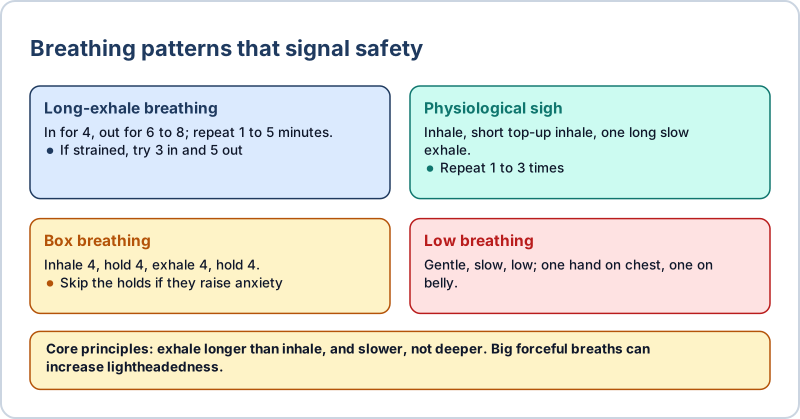
When you inhale, your heart rate speeds up slightly. When you exhale, it slows down slightly. This normal rhythm is called respiratory sinus arrhythmia, and it’s partly driven by the vagus nerve, a major pathway of the parasympathetic “brake.” Making your exhale longer than your inhale gives the brake more time. This is the core principle behind most calming breathing techniques.
The second principle is slower, not deeper. Many anxious people are told to “take a deep breath” and respond by gulping big breaths into the upper chest, which can actually increase lightheadedness. You want gentle, slow, low breathing, not big, forceful breathing.
Protocol 4: Long-Exhale Breathing
The basic pattern (use anywhere):
- Breathe in gently through your nose for a count of 4.
- Breathe out slowly through your nose or pursed lips for a count of 6 to 8.
- Repeat for 1 to 5 minutes.
If 4 in and 6 out feels like a strain, try 3 in and 5 out. The ratio matters more than the numbers. Nobody can tell you’re doing it, which makes it ideal for meetings.
The physiological sigh, or cyclic sighing (fast reset):
- Inhale through your nose.
- Take a second, shorter “top-up” inhale through your nose to fill up your lungs.
- Let out one long, slow exhale through your mouth.
- Repeat 1 to 3 times for a quick reset, or keep going for up to 5 minutes.
A 2023 study published in Cell Reports Medicine by a Stanford team (Balban and colleagues) compared several five-minute daily breathing practices with mindfulness meditation. Participants who practiced cyclic sighing daily for a month showed greater improvements in positive mood and reductions in breathing rate compared with the mindfulness group. It was one study with a modest sample, but it fits well with the long-exhale principle.
Box breathing (for focus under pressure):
Inhale for 4, hold for 4, exhale for 4, hold for 4. Some people find the structure steadying. If holding your breath makes you feel more anxious, skip the holds and just use long exhales.
Low breathing: where the breath goes
Put one hand on your chest and one on your belly. Breathe normally. If the top hand moves a lot and the bottom one barely moves, you’re breathing high in your chest, which is common under stress. Practice letting your belly gently rise on the inhale and fall on the exhale, with your shoulders relaxed. Don’t force it. Just invite it.
Common mistakes
| Mistake | Why it backfires | Fix |
|---|---|---|
| Huge, fast “deep breaths” | Can cause lightheadedness and tingling | Slow and gentle, not big |
| Only practicing in a crisis | The skill isn’t automatic when you need it | Practice daily when calm |
| Forcing it and counting obsessively | Turns breathing into a performance | Aim for “slower-ish,” not perfect |
| Expecting instant calm | Leads to “it doesn’t work” | Expect a 1–3 point drop, not zero |
| Using breathing to escape feelings | Can become another form of avoidance | Breathe with the feeling, not against it |
The last one is important and subtle. Breathing is a tool to help you ride the wave, not a way to make every uncomfortable sensation vanish immediately. If you find yourself thinking “I must calm down right now,” let that go. Try “I’m going to breathe slowly while this is here.”
A note on sensitivity
Some people, especially those who get anxious about body sensations, find that focusing on their breath initially makes them more aware of physical feelings and more anxious. If that’s you:
- Keep your eyes open and focus on something external while you breathe.
- Pair breathing with movement, like walking at a pace of four steps in and six steps out.
- Or start with the grounding tools in Lesson 4.2 and return to breathing later.
People with respiratory, cardiac, or other medical conditions should check with their doctor about breathing practices that involve holds or unusual patterns.
Building the habit
A skill you haven’t practiced won’t be there when you’re at a 7. Attach breathing practice to something you already do every day:
- Three physiological sighs before opening your laptop in the morning
- One minute of 4-6 breathing at every red light or while waiting for the kettle
- Five minutes of cyclic sighing before bed
Action Step
Use Worksheet 2.3: The Breathing Practice Log. Practice Long-Exhale Breathing for five minutes a day for seven days, when you’re calm. Rate your anxiety before and after each session. Mark which pattern worked best for you, and choose one “anchor habit” to attach it to permanently.