When you understand what your body is doing during anxiety, the sensations become less frightening. A pounding heart goes from “something is wrong with me” to “my alarm system is doing its job a bit too enthusiastically.” That shift in interpretation is a tool in its own right.
The two branches
Your autonomic nervous system runs the functions you don’t consciously control: heart rate, breathing, digestion, sweating, and pupil size. It has two main branches that work like an accelerator and a brake:
| Sympathetic (“accelerator”) | Parasympathetic (“brake”) | |
|---|---|---|
| Nickname | Fight or flight | Rest and digest |
| Heart | Speeds up, beats harder | Slows down |
| Breathing | Faster, higher in the chest | Slower, deeper |
| Muscles | Tense, ready to move | Relaxed |
| Digestion | Slows down (hence “butterflies”) | Resumes |
| Attention | Narrows toward threat | Widens |
Both branches are always somewhat active. Anxiety is what happens when the accelerator is pressed harder than the situation calls for, or pressed and then left down.
The alarm sequence
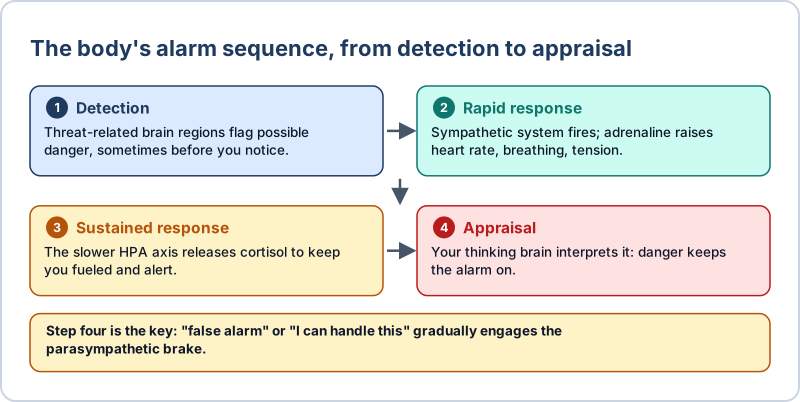
Here’s a simplified version of what happens when your brain detects a possible threat:
- Detection. Brain regions involved in threat and salience, including the amygdala, flag something as possibly dangerous. This can happen before you’re consciously aware of it, which is why you sometimes feel anxious “out of nowhere.”
- Rapid response. The sympathetic nervous system fires. Within seconds, adrenaline is released, and your heart rate, breathing, and muscle tension go up.
- Sustained response. If the threat seems to continue, a slower hormonal pathway (the HPA axis, covered in Lesson 2.2) releases cortisol to keep you fueled and alert.
- Appraisal. Your thinking brain catches up and tries to explain the sensations. If it concludes “danger,” the alarm keeps ringing. If it concludes “false alarm” or “I can handle this,” the brake gradually engages.
Step four is the key. Your interpretation of the body’s response feeds back into the response. “My heart is racing, so something must be wrong” presses the accelerator again. “My heart is racing because I’m about to present, and that’s energy” does not.
Why the sensations happen
Each uncomfortable sensation has a purpose, even if it’s badly timed:
- Racing heart: pumping more blood to your muscles.
- Fast, shallow breathing: bringing in oxygen for action. When it goes on too long it can blow off too much carbon dioxide, which can cause tingling, lightheadedness, or a feeling of unreality.
- Tight muscles: getting ready to move or protect yourself.
- Upset stomach: digestion is put on hold. Blood is directed elsewhere.
- Sweating: cooling you down for exertion.
- Tunnel vision and racing thoughts: attention narrows toward the threat.
- Feeling shaky: extra energy with nowhere to go.
None of these sensations is dangerous in itself for a healthy body. They are uncomfortable, not harmful. (If you have a heart condition or other medical issue, or if sensations are new, severe, or unexplained, get them checked by a doctor. Don’t assume they’re “just anxiety.” See Lesson 6.4.)
Reframing arousal
Research suggests that how you interpret arousal can change how it affects you. In a 2014 study, Harvard Business School researcher Alison Wood Brooks found that people who told themselves “I am excited” before a stressful task, like public speaking or singing, performed better than those who tried to tell themselves to calm down. The body state of anxiety and excitement is similar. The label is different.
This doesn’t mean pretending you feel good. It means trying a more accurate and more useful label: “My body is getting ready. This is energy for the task.” It’s often easier than trying to force calm when your body is already revved up.
Your body is not the enemy
Many people with high-functioning anxiety treat their body like a faulty machine that needs to be overridden. This course takes a different view. Your body is a loyal, somewhat overprotective alarm system. You don’t fight it. You recalibrate it through repeated experiences of safety, using the tools in the rest of this module.
Action Step
Complete Worksheet 2.1: My Body’s Alarm Signature. Check off the sensations you usually get when anxious and note where you feel them first. Then write an accurate, non-catastrophic explanation for each one, like “Tight chest = muscles bracing, not a heart attack.” Keep this page handy. Reading it during a spike can help with step four of the alarm sequence.