Not all worry is the enemy. Some of it is planning in disguise. The trouble starts when worry stops producing anything and just loops. This lesson teaches you to tell the two apart in real time.
Two kinds of worry
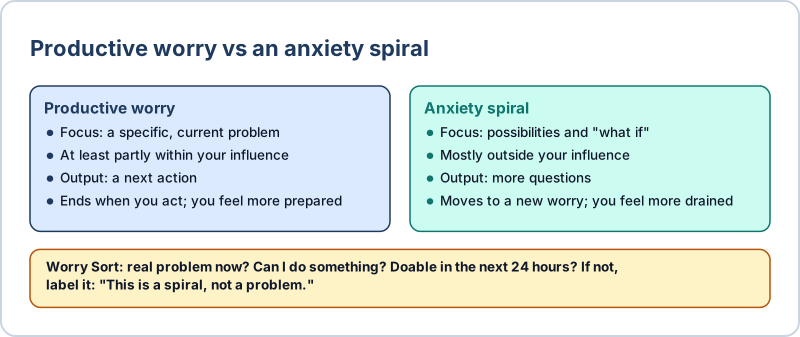
Productive worry is focused on a problem you can actually act on, fairly soon. It leads to a decision or a next step, and it ends once you’ve taken the step.
An anxiety spiral is focused on possibilities rather than problems. It asks “what if” over and over, jumps from topic to topic, rarely lands on an action, and doesn’t end when you take a step. It just finds a new “what if.”
| Productive worry | Anxiety spiral | |
|---|---|---|
| Focus | A specific, current problem | Possibilities, hypotheticals, “what if” |
| Control | At least partly within your influence | Mostly outside your influence |
| Output | A next action | More questions |
| Time horizon | Today, this week | Vague, far future, or “forever” |
| How it ends | You act, and it quiets | It moves on to a new worry |
| Feeling afterward | More prepared | More drained |
The Worry Sort (Protocol 3)
When a worry shows up, run it through three questions:
- Is this a real problem right now, or a hypothetical one? “My presentation is Thursday and I haven’t made slides” is real. “What if everyone thinks I’m a fraud?” is hypothetical.
- Can I do something about it? Even partly, even something small?
- Is there something I can do in the next 24 hours?
If the answers are real, yes, yes, it’s productive worry. Turn it into a next action and put that action somewhere trustworthy, like your calendar or task list. Then let the worry go until the action is done.
If the answers are hypothetical or no, it’s a spiral. Don’t try to solve it. You’ll learn three ways to handle spirals: the Four-Question Check (Lesson 3.2), Uncertainty Reps (Lesson 3.3), and the Worry Window (Lesson 3.4). For now, just label it: “This is a spiral, not a problem.”
Turning productive worry into action
Productive worry only helps if it becomes a next step. Use this formula:
Worry → Specific problem → Smallest next action → When
Example:
- Worry: “I’m behind on everything at work.”
- Specific problem: The Q3 report is due Friday and I have no draft.
- Smallest next action: Open a document and write the five section headings.
- When: 9:00–9:25 tomorrow, before email.
You don’t need to solve the whole problem. The brain calms down when it sees that a problem has an owner and a time.
Why spirals feel productive
Spirals are persuasive because they feel like work. Your mind is busy and it seems to be preparing. But research on generalized worry, including work by Thomas Borkovec at Penn State, suggests that worry can work partly as a mental avoidance strategy. Staying in abstract verbal “what ifs” can dampen some of the emotional and physical intensity of the vivid fear underneath. That brings short-term relief and keeps the pattern going over the long term. A spiral isn’t preparation. It’s a loop.
Catching spirals in real time
Signs you’ve crossed from worry into spiral:
- You’ve had the same thought three or more times in the last ten minutes.
- You’re asking questions no one can answer (“What if it’s cancer?” before any test).
- Each answer produces a new “what if.”
- You’ve been “thinking about it” for twenty minutes and have no written next step.
- You’re seeking reassurance, googling, or rereading the same message.
When you notice these signs, you can say to yourself, “Spiral. I’m not going to solve this by thinking harder.” Naming it is often enough to loosen the loop’s grip.
Imagine this
Dana, a nurse manager, lies awake at 11pm thinking about a staffing gap next month. She runs the Worry Sort: Real? Yes. Can I act? Yes. In 24 hours? Yes, she can email her director tomorrow. She writes “7:30am: email director re: March gap, propose two options” on the notepad by her bed. Then another thought comes: “What if they blame me for turnover?” Sort: hypothetical, not in her control. She labels it a spiral and moves to the sleep tools you’ll learn in Lesson 5.4.
Action Step
Use Worksheet 1.3: The Worry Sort for three days. Each time a worry shows up, run the three questions. For productive worries, write the smallest next action and when you’ll do it. For spirals, simply label them. At the end, count how many were productive and how many were spirals. Most people are surprised by the ratio.