Anxiety is not a character flaw, and it’s not a sign that something is broken. It’s your brain’s threat-prediction system doing its job, sometimes too eagerly. Understanding the mechanism is the first step toward operating it instead of being operated by it.
Fear versus anxiety
Psychologists usually draw a simple distinction:
- Fear is a response to a threat that is here now. A car swerves toward you, and you jump back.
- Anxiety is a response to a threat that might happen. The board meeting is Thursday, the test results come back next week, your teenager is late and not answering.
Both run on the same hardware: a fast alarm system in the brain and body, built to keep you alive. Anxiety is that alarm triggered by prediction instead of by something in front of you. Because humans are extremely good at predicting, imagining, and rehearsing the future, we can set the alarm off from a desk chair at 2pm on a Tuesday.
The anxiety loop
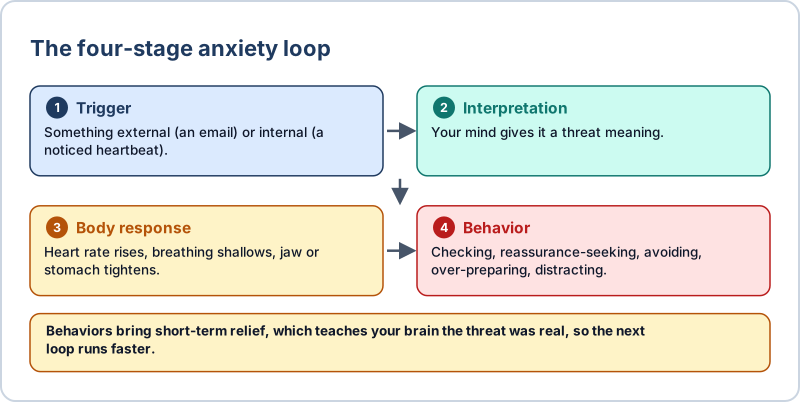
Most anxious episodes follow a four-stage loop:
- Trigger. Something external (an email from your boss, a news alert) or internal (a heartbeat you notice, a memory).
- Interpretation. Your mind gives it meaning, often a threat meaning: “She’s unhappy with my work.” “Something is wrong with my heart.”
- Body response. Your nervous system responds to that meaning. Your heart rate goes up, your breathing gets shallow, your jaw or stomach tightens.
- Behavior. You do something to make the feeling stop, like checking, reassurance-seeking, avoiding, over-preparing, or distracting yourself.
The fourth stage is the sneaky one. Behaviors like avoiding and checking bring short-term relief, and that relief teaches your brain that the threat was real and that the behavior saved you. Next time, the loop runs faster. This is why anxiety often grows even in people who are handling their lives well.
Useful anxiety versus unhelpful anxiety
Some anxiety helps you. It sharpens focus before a presentation and gets you to prepare. Researchers Robert Yerkes and John Dodson described in 1908 a relationship, later popularized as an inverted U, in which moderate arousal tends to support performance and very high arousal tends to degrade it. That’s a simplification, but a useful one. You’re not trying to get rid of anxiety. You’re trying to keep it in the useful zone and to recover faster when it spikes out of it.
Signs anxiety has moved from useful to unhelpful:
- It’s out of proportion to the actual situation.
- It lasts long after the situation has passed.
- It leads you to avoid things that matter to you.
- It eats sleep, attention, or relationships.
The operating system: Notice, Name, Navigate (Protocol 1)
Everything in this course fits one simple sequence. You’ll use it for the rest of the course.
Notice. Catch the loop early, ideally within the first minute or two. Your body is usually faster than your thoughts, so scan physically first. Is your jaw tight? Are you holding your breath? Are your shoulders up? Is your stomach fluttering?
Name. Put it into words, silently, out loud, or on paper: “This is the anxiety loop, triggered by the budget email.” Naming does more than it seems to. In a 2007 brain-imaging study, UCLA psychologist Matthew Lieberman and colleagues found that putting feelings into words (“affect labeling”) was linked to reduced activity in the amygdala, a region involved in threat detection. Naming gives you a small but real bit of distance.
Navigate. Choose one move you decided on in advance. This could be a breathing pattern, a thought check, a grounding exercise, or simply continuing with the task while the feeling rides along. Deciding in advance matters, because an anxious brain is bad at designing plans on the fly. Over the next five modules you’ll fill your “Navigate menu” with tested options.
What this looks like in practice
Imagine Priya, an operations director. At 10:40 she sees a calendar invite from the CEO titled “Quick chat” with no agenda. Her chest tightens.
- Notice: “Chest tight, breath high, I’ve reread the invite four times.”
- Name: “Anxiety loop. Trigger: vague invite. Interpretation: I’m in trouble.”
- Navigate: She does three long exhales and writes one sentence: “Most ‘quick chats’ this year were about projects, not problems.” Then she goes back to her spreadsheet.
The anxiety didn’t disappear. It dropped from a 7 to a 4, and it stopped running her morning. That’s the target.
Action Step
Open Worksheet 1.1: Your Anxiety Loop. Pick one recent anxious moment and break it into the four stages: trigger, interpretation, body response, and behavior. Then write what Notice, Name, Navigate could have looked like. Keep it short. The point is to see the loop, not to judge it.